Quick answer: lower pH with acid, raise it with soda ash or aeration
Aim for a pool pH of 7.4–7.6; the CDC’s acceptable range for home pools is 7.0–7.8. To lower pH, add muriatic acid (31.45%) or dry acid with the pump running: in a 10,000-gallon pool with alkalinity around 100 ppm, roughly 10–13 fl oz of muriatic acid brings pH from 7.8 to 7.5. To raise pH, add soda ash (about 12–16 oz by weight per 10,000 gallons to go from 7.2 to 7.5) or simply aerate the water, which raises pH without raising alkalinity.
This guide contains Amazon affiliate links. As an Amazon Associate, we earn from qualifying purchases, at no extra cost to you. Learn more.
Key takeaways
- pH controls how hard your chlorine works. The CDC notes chlorine loses effectiveness above pH 8.0, and below 7.0 equipment corrosion becomes more likely.
- pH in most pools drifts up, not down, because carbon dioxide escapes from the water. Waterfalls, spa spillovers, salt cells and high alkalinity all speed that up.
- How much acid or base you need depends mostly on total alkalinity. Use your test kit’s acid or base demand test, or a calculator, instead of a fixed number.
- Add about two-thirds of the calculated dose, circulate for at least 30 minutes to a few hours, then retest.
- If pH keeps rising every few days, lower total alkalinity instead of adding more acid forever.
- Never mix acid with chlorine, and always add acid to water, never water to acid.
What pool pH should be, and what happens when it’s off
pH measures how acidic or basic your water is on a scale of 0 to 14, with 7 as neutral. It’s logarithmic: water at pH 7.0 is ten times more acidic than water at 8.0. That’s why a “small” change from 7.5 to 7.9 makes a real difference to how your water behaves.
The CDC recommends a pH of 7.0–7.8 for home pools and hot tubs. Taylor Technologies, the test-kit maker, gives a tighter ideal of 7.4–7.6, which is where most pool owners should aim. That band is comfortable for swimmers, high enough to protect plaster and metal while low enough to keep chlorine effective.
| pH reading | What it means | What to do |
|---|---|---|
| Below 7.0 | Too acidic. Stinging eyes, corrosion of metal parts and heater, etching of plaster, wrinkling of vinyl. | Raise pH now; check alkalinity, which is often low too |
| 7.0–7.3 | Within CDC range but low. Chlorine is very active, water may feel harsh. | Raise to 7.4–7.6 with soda ash or aeration |
| 7.4–7.6 | Ideal. | Nothing; recheck in a day or two |
| 7.7–7.8 | Top of the CDC range. Chlorine slower, scale more likely on tile and salt cells. | Lower with a small acid dose |
| Above 7.8 | Too high. Cloudy water, scale, poor chlorine performance; the CDC says chlorine loses effectiveness above 8.0. | Lower with acid; check alkalinity |
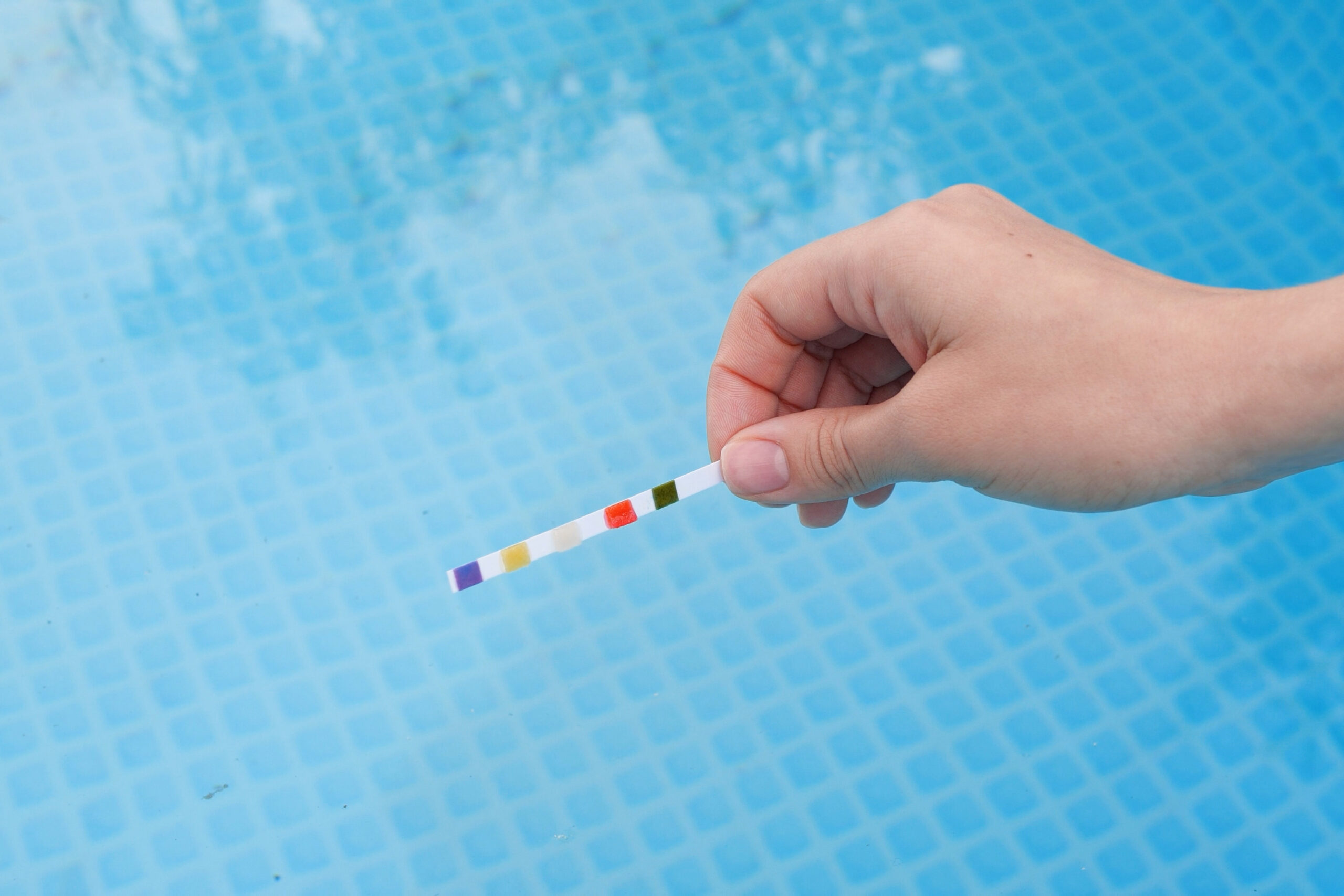
Phenol red, the indicator in most kits, only reads from about 6.8 to 8.2. If your reading is at the very top or bottom of the scale, the true pH could be further out, so dose in steps and retest rather than assuming you’re only slightly off. Also note that chlorine above 10 ppm can distort pH readings; test pH when chlorine is at a normal level.
How to lower pH in a pool
You have two practical options: muriatic acid (hydrochloric acid, usually sold at 31.45% strength, sometimes at half strength around 14.5–15%) and dry acid (sodium bisulfate, usually 93%). Muriatic acid is cheaper per dose and adds nothing that builds up except chloride, which is the same thing as salt. Dry acid is easier and safer to handle, but adds sulfates, which build up over the years and which some salt-cell and plaster makers ask you to keep low. Many owners keep muriatic for routine use.
How much acid to add
The acid your pool needs depends on total alkalinity, and to a lesser degree on cyanuric acid and borates, all of which buffer pH. The figures below are worked out from carbonate chemistry for a 10,000-gallon pool with about 40 ppm cyanuric acid, using 31.45% muriatic acid. Treat them as starting points.
| Total alkalinity | pH 7.8 to 7.5 | pH 8.2 to 7.5 |
|---|---|---|
| 80 ppm | About 9–10 fl oz | About 15–16 fl oz |
| 100 ppm | About 11 fl oz | About 18 fl oz |
| 120 ppm | About 13 fl oz | About 20 fl oz |
Scale by volume: double these for 20,000 gallons, halve them for 5,000. If you use half-strength acid, roughly double the volume. If you use dry acid instead, about 1.3 oz by weight of sodium bisulfate does the work of 1 fl oz of 31.45% muriatic acid. Our pool calculator does this math for your exact volume and readings.
A more precise route is the acid demand test included in kits such as the Taylor K-2006. After reading pH, you add acid demand reagent drop by drop to the same sample until it reaches your target color, then convert the drop count to a dose with the kit’s treatment table. Because it measures your actual water, it automatically accounts for alkalinity and other buffers.
Step by step: adding muriatic acid
- Put on goggles and chemical-resistant gloves. Muriatic acid fumes irritate the lungs and eyes, and splashes burn skin. Work outdoors, upwind.
- Turn on the pump and keep swimmers out of the pool.
- Measure about two-thirds of your calculated dose into a clean, acid-only plastic measuring cup. Don’t use a cup that’s ever held chlorine.
- Pour slowly into the deep end in front of a return jet, close to the water surface to limit splashing and fumes. Some owners pre-dilute in a bucket: fill the bucket with pool water first, then add the acid. Never add water to acid.
- Brush the area if you have a plaster pool and acid could settle on the floor.
- Circulate for at least 30 minutes, preferably a few hours, then retest pH. Add the rest of the dose only if needed.
- Rinse your gear and store the acid capped, upright and away from chlorine products.
If you need a large correction, split it across two sessions a few hours apart rather than pouring it all at once. Big single doses make it easy to overshoot and can concentrate acid on one spot of the pool surface.
How to raise pH in a pool
Low pH is less common than high pH, but it shows up after heavy rain, after overshooting with acid, or in pools that use trichlor tablets, which are acidic. Before you add anything, check total alkalinity. If TA is low (under 80 ppm), fix that first with baking soda, which also nudges pH up. Our guide to raising and lowering total alkalinity covers that step.
| Method | Effect on pH | Effect on alkalinity | Best for |
|---|---|---|---|
| Aeration (fountains, jets pointed up, waterfalls) | Raises slowly over a day or more | None | pH low but TA already in range |
| Soda ash (sodium carbonate) | Raises quickly | Raises noticeably | pH low and TA low or normal |
| Baking soda (sodium bicarbonate) | Raises slightly | Raises strongly (1.5 lb = +10 ppm per 10,000 gal) | TA low; pH only a little low |
| Borax | Raises moderately | Raises slightly | Owners who also use borates |
Working from the same chemistry as the acid table, about 15 oz by weight of soda ash raises pH from 7.2 to 7.5 in a 10,000-gallon pool with TA at 80 ppm and 40 ppm CYA, and adds roughly 10 ppm of alkalinity along the way. Swim University’s rule of thumb, 6 oz per 10,000 gallons for about a 0.2 rise, is a reasonable first step for pools with lower alkalinity. Start low either way.
Step by step: adding soda ash
- Run the pump and measure your dose by weight. Use about half the calculated amount on the first round.
- Dissolve the soda ash in a bucket of pool water (water first, then powder). Undissolved soda ash can cloud the water.
- Pour it slowly around the deep end or in front of a return.
- Wait several hours with the pump running, then retest pH and alkalinity before adding more.
Don’t add more than a pound or so per 10,000 gallons at one time. Large doses of soda ash, especially in water with high calcium, can make the pool cloudy as calcium carbonate drops out of solution.
Why pool pH keeps rising (or falling)
If you’re adding acid every couple of days, the acid isn’t the problem; something is pushing pH up. The main driver is carbon dioxide. Pool water normally holds more dissolved CO2 than air does, and as that CO2 escapes, pH rises. Orenda, a pool chemical maker that publishes a lot on this topic, lists the usual causes:
- Aeration. Waterfalls, spillover spas, deck jets, bubblers and even heavy swimming drive CO2 out faster.
- High total alkalinity. More alkalinity means more dissolved carbon to escape, so pH climbs faster and higher.
- Salt chlorine generators. The cell’s fine bubbles aerate the water, so salt pools need acid regularly.
- Unstabilized chlorine. Liquid chlorine and cal-hypo both have high pH and nudge pool pH up.
- New plaster. Curing plaster releases calcium hydroxide for roughly the first 30–60 days, which pushes pH up sharply.
- Algae. Growing algae consume CO2; Orenda reports a green pool measuring pH 10.3. See why your pool turns green.
The fix for constant upward drift is usually to lower total alkalinity toward 70–80 ppm (lower still for some salt pools, as long as pH stays stable). With less carbonate in the water, there’s less CO2 to outgas and pH settles. Orenda suggests 60–70 ppm TA for many salt, liquid-chlorine and cal-hypo pools; that is a reasonable target to test, not a rule for every pool.
Falling pH is usually caused by trichlor tablets, which are acidic, by acidic rain, or by low alkalinity that lets pH swing. If you use trichlor, expect to add base periodically, and watch your stabilizer level too, because every tablet also adds cyanuric acid. Our cyanuric acid guide explains why that matters.
Safety when handling acid and pH chemicals
- Never mix acid and chlorine. The CDC warns that this combination releases toxic chlorine gas. Add them hours apart, at different spots, with separate tools.
- Add chemical to water, not water to chemical. Adding water to concentrated acid can make it boil and spatter.
- Store acid low, upright and away from chlorine, in its original container, out of the sun and locked away from children and pets. Acid fumes corrode metal shelving and nearby equipment.
- If acid splashes in your eyes, flush with clean water for at least 15 minutes and call Poison Control at 1-800-222-1222. Call 911 for trouble breathing or severe burns.
Products worth a look
Widely sold, well-reviewed options that match the advice above. We have not tested them ourselves; check the label, size and compatibility with your pool or spa before you buy. Prices change often, so we don’t list them.
- Taylor K-2006C Service Complete Pool Water Test Kit: includes acid and base demand tests for exact pH doses. Check price on Amazon
Common mistakes to avoid
- Adjusting pH before alkalinity. If TA is out of range, fix it first or pH won’t hold.
- Using a fixed “ounces per 0.1 pH” number. The same dose that moves pH 0.3 in a low-TA pool may barely move it in a high-TA pool.
- Retesting too soon. Give acid at least 30 minutes of circulation and soda ash a few hours.
- Testing right after shocking. High chlorine can throw off the pH indicator.
- Overshooting with soda ash. It raises alkalinity too, and in hard water it can cloud the pool.
- Using old reagents. Replace test reagents roughly once a year; old phenol red gives unreliable readings.
Frequently asked questions
What causes low pH in a pool?
The usual causes are trichlor tablets (which are acidic), dry acid or muriatic acid overdoses, heavy rain, and low total alkalinity that lets pH fall easily. Check TA first; if it’s below 80 ppm, raise it with baking soda before correcting pH.
Can I use baking soda to raise pH?
Baking soda raises alkalinity much more than it raises pH. Use it when both are low. If only pH is low and alkalinity is fine, use aeration or a small dose of soda ash instead.
How long after adding acid can I swim?
Wait until the acid has circulated, at least 30 minutes and ideally a few hours, then retest. Swim once pH is back between 7.2 and 7.8 and the product label’s directions have been followed.
Does high pH make a pool cloudy?
It can. Above about 7.8, especially with high calcium or alkalinity, calcium carbonate starts coming out of solution, and chlorine also works less efficiently. Our guide to clearing cloudy pool water covers the other causes.
Should I lower pH or alkalinity first?
Alkalinity first. Acid lowers both, so if TA is high, your acid doses will bring it down and pH along with it. Once TA is in range, fine-tune pH. Our pool chemistry guide lays out the full adjustment order.
Sources
- CDC: Home pool and hot tub water treatment and testing
- Taylor Technologies: Beginner’s guide to pool and spa water chemistry testing
- Orenda: What causes high pH in a swimming pool
- Orenda: CO2, pH and Henry’s law
- Swim University: How to use soda ash to raise pool pH
- CDC: Use pool chemicals safely (poster)