Quick answer: the levels most pools should aim for
Keep pH at 7.4–7.6, total alkalinity at 80–120 ppm, calcium hardness at 200–400 ppm and cyanuric acid (stabilizer) at 30–50 ppm. Free chlorine should never drop below the CDC minimum of 1 ppm (2 ppm if you use stabilizer), and in practice about 7.5% of your cyanuric acid level works well, for example 3–5 ppm at 40 ppm CYA. Test chlorine and pH often, test the rest weekly, and adjust in this order: alkalinity, pH, calcium, stabilizer, then chlorine.
This guide contains Amazon affiliate links. As an Amazon Associate, we earn from qualifying purchases, at no extra cost to you. Learn more.
Key takeaways
- Pool chemistry comes down to six numbers: free chlorine, pH, total alkalinity, calcium hardness, cyanuric acid and combined chlorine.
- Free chlorine is the only one that kills germs. The others decide how well that chlorine works and whether your water damages the pool.
- Your chlorine target depends on your stabilizer level. More cyanuric acid means you need more free chlorine to get the same effect.
- A liquid reagent kit (DPD or FAS-DPD) is more accurate than test strips, according to the CDC.
- Add one chemical at a time, to the water, with the pump running. Never mix chemicals, especially acid and chlorine.
- Doses depend on product strength. Always check the percentage on the label before you measure.
Ideal pool chemical levels at a glance
The table below combines the CDC’s minimums for home pools with the working ranges Taylor Technologies publishes for residential pools. Taylor is the company behind the most widely used liquid test kits, and its ranges are a sensible default if your sanitizer label or a local code doesn’t say otherwise. Where a product label lists a different range, the label wins: pool sanitizers are EPA-registered pesticides, and using them against label directions violates federal law.
| Parameter | Target for a residential pool | What it does | How often to test |
|---|---|---|---|
| Free chlorine (FC) | 2–4 ppm (Taylor); never below 1 ppm, or 2 ppm with stabilizer (CDC) | Kills germs and algae | Daily in season, more after heavy use |
| Combined chlorine (CC) | Under 0.4 ppm | Used-up chlorine (chloramines); causes “chlorine smell” | Weekly |
| pH | 7.4–7.6 (CDC acceptable range 7.0–7.8) | Controls chlorine strength, comfort and corrosion | Daily in season |
| Total alkalinity (TA) | 80–120 ppm | Buffers pH so it doesn’t swing | Weekly |
| Calcium hardness (CH) | 200–400 ppm | Protects plaster and grout from etching; too high causes scale | Monthly |
| Cyanuric acid (CYA) | 30–50 ppm (outdoor pools) | Shields chlorine from sunlight | Every 2–4 weeks |
Two of these numbers deserve extra explanation, because they cause most beginner confusion: the chlorine target and its relationship with stabilizer.
Why your chlorine target depends on cyanuric acid
Cyanuric acid binds part of your chlorine to protect it from the sun. That protection is the reason outdoor pools hold chlorine through a summer afternoon, but the bound chlorine is also slower to kill germs. The CDC notes that disinfection takes longer when cyanuric acid is present, which is why it raises its pool minimum from 1 ppm to 2 ppm for stabilized pools.
Trouble Free Pool, a large pool-owner community, publishes a chart that ties the free chlorine target to the CYA level. A few rows for pools sanitized with liquid chlorine:
| CYA level | Minimum FC | Target FC | Shock (SLAM) level |
|---|---|---|---|
| 20 ppm | 2 ppm | 3–5 ppm | 10 ppm |
| 30 ppm | 2 ppm | 4–6 ppm | 12 ppm |
| 40 ppm | 3 ppm | 5–7 ppm | 16 ppm |
| 50 ppm | 4 ppm | 6–8 ppm | 20 ppm |
| 60 ppm | 5 ppm | 7–9 ppm | 24 ppm |
The pattern is roughly 7.5% of CYA as the floor and 40% of CYA as the shock level. If your CYA creeps above 80–100 ppm, the chlorine you need becomes impractical, and the only real fix is partially draining and refilling. Our guide to cyanuric acid covers how to lower it.
The pool chemicals beginners actually need
Pool stores sell dozens of products, but almost every residential pool runs on a short list. Each one moves one or two numbers, and knowing which is which keeps you from fixing one problem and creating another.
- Liquid chlorine (sodium hypochlorite, 10% or 12.5%). Raises free chlorine with no side effects on CYA or calcium. It raises pH slightly at first, but that rise is mostly undone as the chlorine is used up.
- Trichlor tablets (about 90% available chlorine). Convenient in a floater or feeder, but acidic, and they add stabilizer: every 1 ppm of chlorine from trichlor adds about 0.6 ppm of CYA.
- Dichlor granules (about 56–62% available chlorine). Dissolve fast and are close to pH neutral, but add about 0.9 ppm of CYA for every 1 ppm of chlorine.
- Calcium hypochlorite “shock” (often 65–73%). Strong and stabilizer-free, but adds calcium: about 0.7 ppm of calcium hardness for every 1 ppm of chlorine.
- Muriatic acid (31.45% hydrochloric acid) or dry acid (sodium bisulfate). Lower pH and total alkalinity.
- Baking soda (sodium bicarbonate). Raises total alkalinity with only a small effect on pH.
- Soda ash (sodium carbonate). Raises pH quickly, and alkalinity along with it.
- Calcium chloride. Raises calcium hardness.
- Cyanuric acid (stabilizer or conditioner). Raises CYA. It dissolves slowly and stays in the water until you drain.
The stabilizer math is the trap most new owners fall into. If you chlorinate only with trichlor tablets all summer, CYA keeps climbing, and the chlorine level that used to work stops working. A good beginner pattern is to use liquid chlorine as the main sanitizer and add CYA on purpose, to a known target, once or twice a season. Note that the EPA also asks makers of oxidizer-only “shock” products to state on the label that they are not a sanitizer or algicide, so read what a bag actually does before you buy it.
Dosing guide: how much to add per 10,000 gallons
The amounts below are worked out from basic chemistry for the product strengths listed. Scale them to your pool: a 20,000-gallon pool needs twice as much, a 5,000-gallon pool half. If you don’t know your volume, our pool calculator works it out from your dimensions and does this math for you.
| Goal | Product (strength) | Amount per 10,000 gal | Notes |
|---|---|---|---|
| Raise FC by 1 ppm | Liquid chlorine, 12.5% | About 10 fl oz | 1 gallon raises FC about 12.5 ppm |
| Raise FC by 1 ppm | Liquid chlorine, 10% | About 13 fl oz | 1 gallon raises FC about 10 ppm |
| Raise FC by 1 ppm | Cal-hypo, 73% | About 1.8 oz by weight | Also adds about 0.7 ppm calcium |
| Raise TA by 10 ppm | Baking soda | 1.5 lb | Raises pH only slightly |
| Lower TA by 10 ppm | Muriatic acid, 31.45% | About 26 fl oz | Lowers pH too; aerate to bring pH back up |
| Lower TA by 10 ppm | Dry acid (sodium bisulfate, 93%) | About 2.1 lb | Adds sulfates over time |
| Raise CH by 10 ppm | Calcium chloride, 77% | About 1.2 lb | Dissolve in a bucket of pool water first; it gets hot |
| Raise CYA by 10 ppm | Cyanuric acid, 100% | About 13 oz by weight | Takes days to fully dissolve and register |
| Raise pH about 0.2 | Soda ash | About 6 oz by weight | Varies with alkalinity; add in small steps |
pH is the one number a simple table can’t predict well, because the acid or base you need depends on your alkalinity, and to a lesser degree on your stabilizer and borate levels. That’s why good test kits include an acid demand and base demand test. Our guide to raising and lowering pH walks through those tests and gives starting doses.
How to test and balance your pool water, step by step
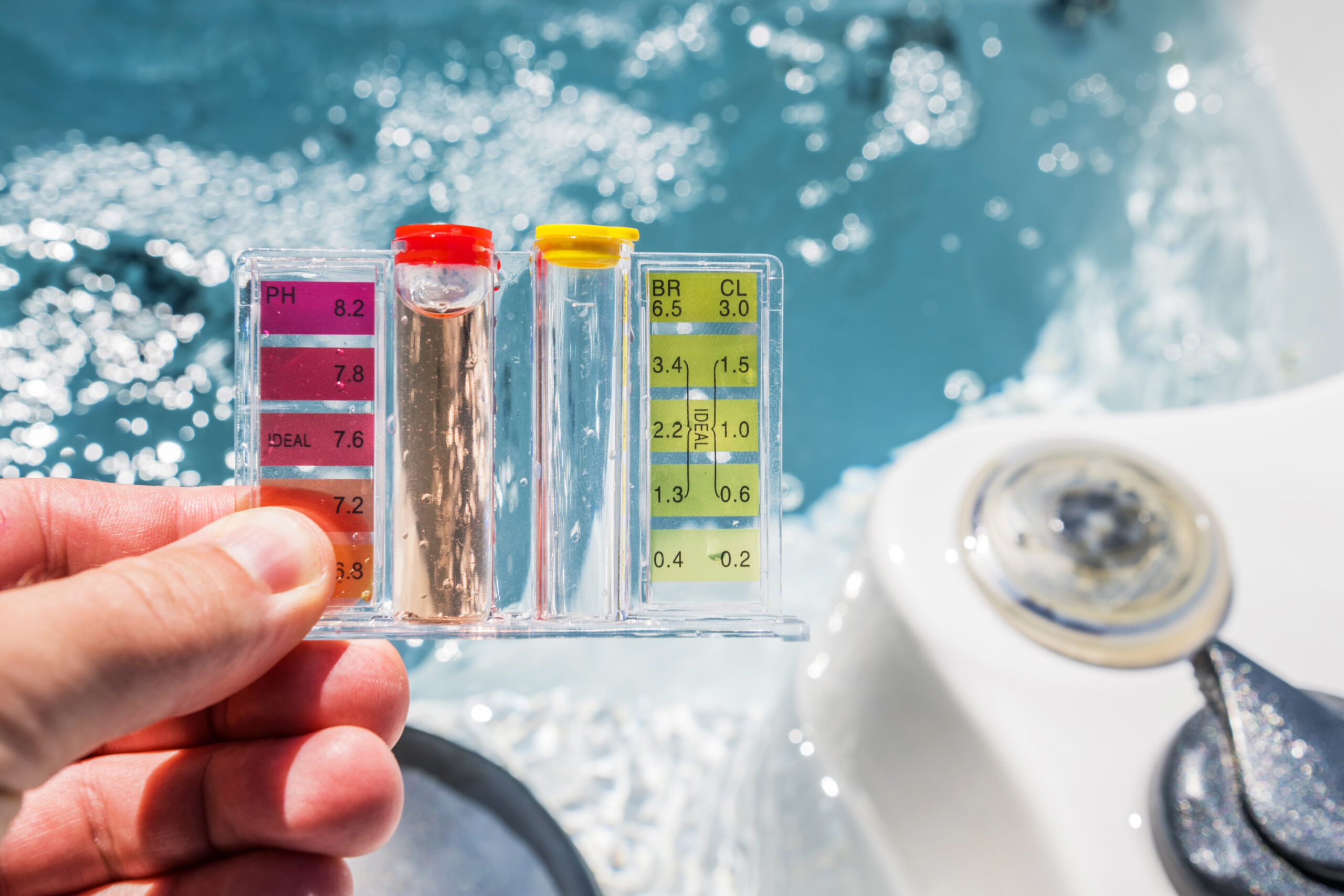
The CDC recommends a DPD test kit as the most accurate home option and says test strips are less accurate. It also warns that chlorine above 10 ppm can bleach a DPD sample and read falsely low or even zero, which matters right after you shock. FAS-DPD kits, like Taylor’s K-2006, avoid that problem by counting drops instead of matching colors. Strips are fine for a quick daily check between full tests.
- Take a proper sample. Collect water from elbow depth, away from return jets and the skimmer. Test at about the same time each day; Taylor suggests mornings, before sunlight eats into the chlorine.
- Run the full panel. Free and combined chlorine, pH, total alkalinity, calcium hardness and CYA. Write the numbers down with the date.
- Fix total alkalinity first. TA steers pH, so adjusting pH before TA usually means doing it twice. See our guide to raising and lowering total alkalinity.
- Then adjust pH. Use acid to lower it, soda ash to raise it. Add no more than about half to three-quarters of the calculated dose, wait, then retest.
- Adjust calcium hardness and CYA if they are out of range. These change slowly, so you’ll usually do this a few times a season, not weekly.
- Bring free chlorine to the target for your CYA. Add it last, ideally in the evening, so the sun doesn’t burn it off right away.
- Circulate and wait before retesting. Run the pump while adding chemicals and give the water a few hours of circulation (overnight for calcium and stabilizer) before you test again.
How often? The CDC’s guidance for home pools is to check chlorine and pH at least twice a day, and more often when the pool is busy. Many owners settle on a daily chlorine and pH check during swim season plus a full panel once a week. Our pool maintenance checklist lays out the full routine.
What happens when each level is off
Knowing the symptoms helps you read your water before you test it, and helps you decide which number to fix first. If you already have a visible problem, our pool problem diagnostic walks you from symptom to cause.
- Low free chlorine: cloudy water, slippery walls, then algae. A pool can go from clear to green in a day or two in hot weather. See why your pool turns green.
- High combined chlorine: the strong “chlorine smell” and red eyes people blame on too much chlorine. It is actually a sign of too little working chlorine. Shocking breaks combined chlorine down; our guide on how to shock a pool covers doses.
- High pH (above 7.8): chlorine works more slowly; the CDC notes it loses effectiveness against germs above 8.0. Cloudy water and white scale on tile are common.
- Low pH (below 7.2): stinging eyes and, according to the CDC, a higher chance of corroding pipes and equipment. Low pH also etches plaster and wrinkles vinyl liners over time.
- High alkalinity: pH keeps drifting up no matter how much acid you add.
- Low alkalinity: pH bounces around and crashes after rain or a dose of acid.
- Low calcium hardness: water pulls calcium out of plaster, grout and pebble finishes, causing rough, pitted surfaces.
- High calcium hardness: scale on tile lines, heater elements and salt cells, and cloudy water when pH runs high.
- High CYA: algae and cloudy water even though the chlorine reading looks “normal.”
What “water balance” means
pH, alkalinity, calcium and temperature together decide whether water is aggressive (dissolves plaster and metal) or scaling (deposits calcium). That’s why a pool with high calcium needs pH kept near 7.4. Plaster, pebble and quartz finishes are the most sensitive; vinyl and fiberglass are more forgiving, but scale still forms on heaters and salt cells.
Handling pool chemicals safely
Pool chemicals are concentrated and reactive. A CDC report published in 2019 estimated 13,508 emergency department visits for pool chemical injuries in 2015–2017, roughly 4,500 a year, and at least 56% of the injuries happened at a residence. The CDC’s own storage and handling posters boil the prevention down to a few rules:
- Never mix chemicals with each other, and never mix different types of chlorine. Chlorine plus acid releases toxic chlorine gas; cal-hypo mixed with other chemicals can cause a fire or explosion, according to product labels.
- Add chemical to water, never water to chemical. When you predissolve something in a bucket, fill the bucket with pool water first, then add the product.
- Use separate, labeled scoops and buckets for each chemical, and add products one at a time with time to circulate in between.
- Wear eye protection and chemical-resistant gloves, especially when pouring acid, and work outdoors or in a well-ventilated area.
- Store chemicals cool, dry, out of the sun and in their original containers, with acids kept away from chlorine and liquids stored low. Lock them away from children and pets.
- Keep swimmers out while you add chemicals, and check the label for when swimming can resume. Several chlorine labels say not to swim when free chlorine is above 4 ppm.
If someone swallows a pool chemical or gets it in their eyes, call Poison Control at 1-800-222-1222. For trouble breathing, burns or collapse, call 911.
Products worth a look
Widely sold, well-reviewed options that match the advice above. We have not tested them ourselves; check the label, size and compatibility with your pool or spa before you buy. Prices change often, so we don’t list them.
- Taylor K-2006C Service Complete Pool Water Test Kit: FAS-DPD drop-count chlorine test plus pH, TA, CH and CYA. Check price on Amazon
- AquaChek 7-Way Pool and Spa Test Strips (100 strips): quick daily chlorine and pH spot checks between full tests. Check price on Amazon
Common mistakes to avoid
- Guessing your pool volume. Every dose depends on it. Measure once and write it down.
- Relying only on test strips. They are handy for daily checks, but use a liquid kit before making big adjustments.
- Chasing pH while ignoring alkalinity. If TA is off, pH won’t stay put.
- Using only stabilized chlorine all season. Trichlor and dichlor keep adding CYA until your chlorine stops working.
- Dumping the full calculated dose at once. Add part, circulate, retest. Overshooting means buying a second chemical to undo the first.
- Assuming a strong chlorine smell means too much chlorine. It usually means combined chlorine and not enough free chlorine.
Frequently asked questions
What chemicals do I need for a pool as a beginner?
A reliable test kit, a chlorine source (liquid chlorine is the simplest), muriatic acid or dry acid to lower pH and alkalinity, baking soda to raise alkalinity, and a bag of cyanuric acid if your pool is outdoors and you don’t use stabilized tablets. Add calcium chloride only if your test shows calcium hardness below range.
In what order should I add pool chemicals?
Total alkalinity first, then pH, then calcium hardness and stabilizer, and chlorine last. Run the pump the whole time and wait several hours between products, or overnight after calcium or stabilizer. Never add two products together.
How often should I test my pool water?
The CDC recommends checking chlorine and pH at least twice a day for home pools, more when the pool is in heavy use. At a minimum, test chlorine and pH daily in swim season, alkalinity weekly, calcium hardness monthly and CYA every two to four weeks.
Is 7.8 pH too high for a pool?
It is at the top of the CDC’s acceptable 7.0–7.8 range, so it’s not unsafe, but chlorine works less efficiently there and scale becomes more likely. Bring it down toward 7.4–7.6 with a small dose of acid.
Are hot tub levels the same as pool levels?
No. The CDC recommends at least 3 ppm of free chlorine in hot tubs and advises against cyanuric acid or stabilized chlorine in them. Taylor lists 150–250 ppm calcium hardness for spas and 3–5 ppm for bromine. See our hot tub maintenance guide.
Can I swim right after adding chemicals?
Wait until the product has circulated and your levels are back in range; the label gives the specific re-entry rule. For chlorine, many labels say to stay out until free chlorine is 4 ppm or lower. After acid, give it at least 30 minutes of circulation and retest pH.
Sources
- CDC: Home pool and hot tub water treatment and testing
- Taylor Technologies: The beginner’s guide to pool and spa water chemistry testing
- Trouble Free Pool: Free chlorine and cyanuric acid chart
- CDC: Store pool chemicals safely (poster)
- CDC: Use pool chemicals safely (poster)
- CDC MMWR: Pool chemical injuries in public and residential settings, 2008–2017
- EPA: Use of the term “shock” in pool, hot tub and spa products