Quick answer: a cartridge filter is the best all-round choice for most residential pools, sand is the cheapest and simplest, and DE gives the clearest water.
Hayward rates sand filters at 20–40 microns, cartridge filters at 10–20 microns and DE filters at 3–5 microns. Unit prices run about $300–$1,200 for sand, $200–$1,600 for cartridge and $520–$2,000 for DE (Fixr, as of November 2026). Clean or backwash any of them when the pressure gauge reads 8–10 psi above its clean reading.
This guide contains Amazon affiliate links. As an Amazon Associate, we earn from qualifying purchases, at no extra cost to you. Learn more.
Key takeaways
- Sand (20–40 microns): lowest effort, cheapest media, but it wastes water every time you backwash and leaves the finest haze in the water.
- Cartridge (10–20 microns): no backwashing, so you keep your water and your chemistry. You hose the element off a few times a season and replace it every 1–3 years.
- DE (3–5 microns): the finest filtration available for home pools, but it is the most expensive and the most hands-on. You also handle a powder you should not breathe.
- Size the filter to your pump’s flow, not just your pool’s gallons, then go one size up. A larger filter runs longer between cleanings.
- The 8–10 psi rule applies to all three types. Write down the clean pressure reading the day you clean or install the filter.
How each pool filter works
Every pool filter does the same job: your pump pushes water through a medium that traps particles, and clean water returns to the pool. The three types differ in what that medium is, how fine a particle it can hold, and how you get the dirt back out.
Sand filters
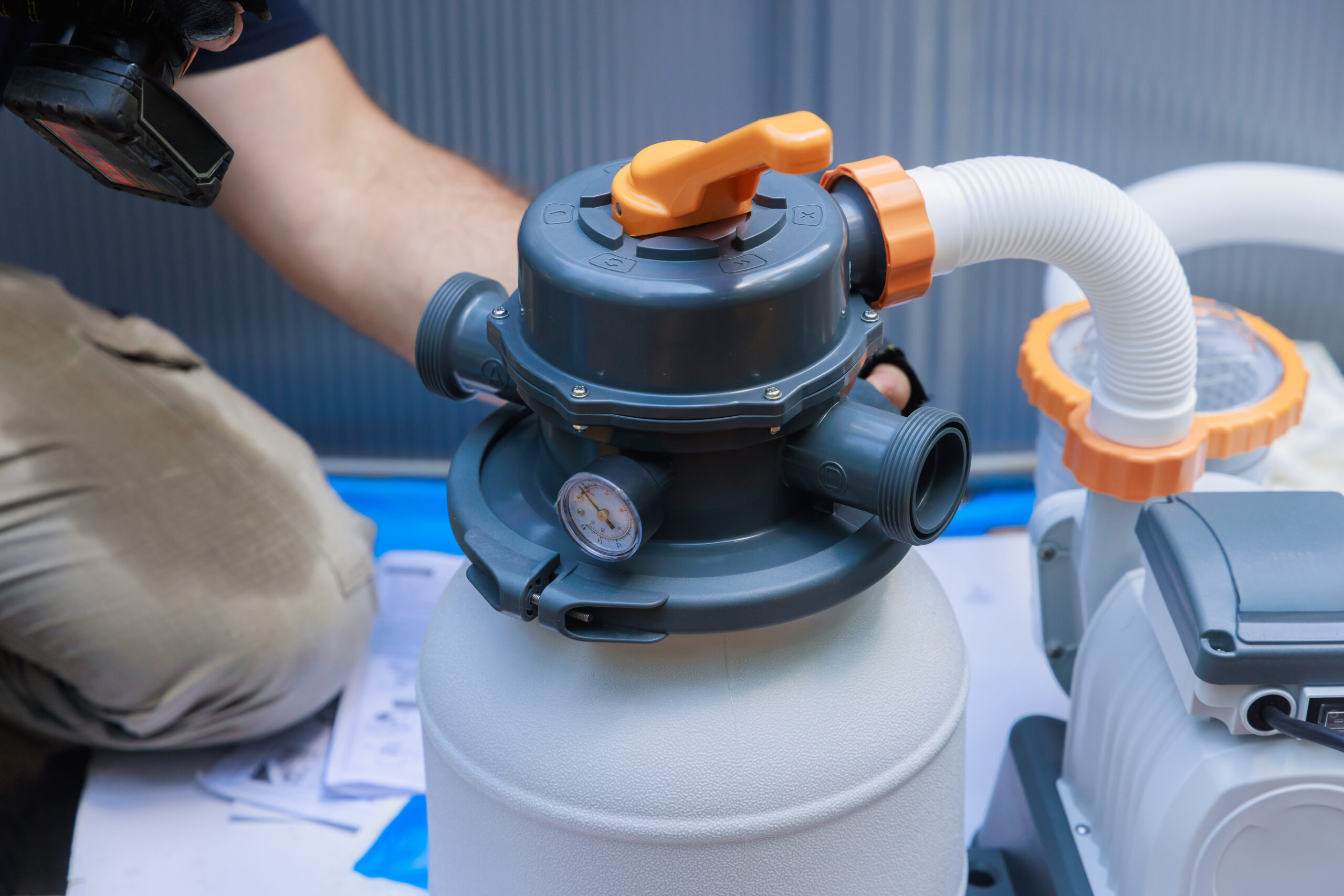
A sand filter is a tank filled with specially graded pool filter sand, usually #20 silica. Water enters at the top, works its way down through the sand bed, and leaves through slotted laterals at the bottom. Dirt lodges between the sand grains. As the bed fills, the pressure rises. To clean it, you backwash: set the multiport valve to Backwash so water flows up through the bed and out to waste, then run Rinse briefly to resettle the sand.
Hayward notes that a sand filter actually gets a little more efficient as it loads up, because trapped dirt fills the gaps between grains. It also says sand typically lasts about five years before its first replacement. Over time the grains round off and clump, and the bed stops filtering well.
Cartridge filters
A cartridge filter holds one or more pleated polyester elements inside a tank. Water passes through the fabric from the outside in, and the large pleated surface catches debris down to 10–20 microns. There is no backwash. When the pressure climbs 8–10 psi, you shut the pump off, open the tank, pull the cartridge and hose it off.
Because you never dump water to waste, a cartridge filter saves water and keeps your chemical levels stable after cleaning. Hayward calls it the fastest-growing filter type. The trade-off is a replacement cartridge every one to three years, at $30–$200 each according to HomeGuide.
DE (diatomaceous earth) filters
A DE filter has a set of fabric-covered grids (or flex tubes) inside the tank. You add DE powder, the fossilized skeletons of microscopic algae called diatoms, through the skimmer. It coats the grids and forms the actual filtering layer. That porous coating traps particles as small as 3–5 microns. For scale, Hayward points out that a human hair is 40–50 microns wide.
Most DE filters are backwashed like sand filters, which flushes out the dirty DE. You then add a fresh charge of powder. A few times a year you also break the filter down and hose the grids clean. Hayward recommends inspecting the grids for tears whenever you do. A torn grid lets DE blow back into the pool as a fine gray dust on the floor.
Sand filter vs. cartridge filter vs. DE: side-by-side comparison
| Factor | Sand | Cartridge | DE |
|---|---|---|---|
| Smallest particle captured (Hayward) | 20–40 microns | 10–20 microns | 3–5 microns |
| Unit price (Fixr, Nov 2026) | $300–$1,200 | $200–$1,600 | $520–$2,000 |
| How you clean it | Backwash + rinse | Remove and hose off | Backwash + recharge DE; full grid cleaning a few times a year |
| Clean when pressure rises | 8–10 psi | 8–10 psi | 8–10 psi |
| Media replacement | Sand about every 5 years | Cartridge every 1–3 years | Fresh DE after every backwash; grids last for years |
| Water lost when cleaning | High (backwash to waste) | Minimal | High (backwash to waste) |
| Maintenance effort | Low | Low to moderate | Moderate to high |
| Typical design flow rate | 20 gpm per sq ft | 1 gpm per sq ft or less | 2 gpm per sq ft |
Micron ratings vary a little from source to source because manufacturers measure them differently, but the ranking never changes: DE is finest, cartridge is in the middle and sand is the coarsest.
Which pool filter is best for you?
Skip the “which is best” debate and match the filter to how you actually run your pool.
Choose sand if you want the least work and lowest upfront cost
Sand suits a pool owner who wants to turn a valve for three minutes once a week or two and forget about it. Media is cheap: Fixr lists a 50 lb bag of filter sand at $25–$35. Sand also tolerates heavy debris loads well, which helps if your yard drops a lot of leaves and pollen. The downsides are water use and clarity. Sand lets the finest particles through, so you may need a clarifier more often, and every backwash drains water you then refill and rebalance.
Choose cartridge if you want good clarity and stable chemistry
For most residential pools, cartridge is the sweet spot. It filters roughly twice as fine as sand. It keeps your water in the pool, which matters in drought-restricted areas and for salt pools, since every gallon you backwash out takes salt with it. It also keeps the stabilizer (CYA) and alkalinity you paid for. Cartridge filters run at low pressure, which suits variable-speed pumps. Plan on hosing the element off two to four times a season, and soaking it in a filter cleaner once a year.
Choose DE if water clarity is your top priority
If you entertain at night with pool lights on, or you simply want the clearest water possible, DE is the answer. Hayward specifically recommends DE for lighted pools used at night. DE also clears a cloudy pool faster than the other two, because it pulls out the tiny particles that cause haze. You pay for that with the highest purchase price, regular powder purchases, more cleaning work, and the need to handle a dusty powder safely (see the safety section below).
How to size a pool filter
An undersized filter clogs fast, runs at high pressure and needs constant cleaning. Size it in four steps:
- Find your pool volume in gallons. Multiply length × width × average depth (in feet) × 7.48 for a rectangular pool, or use our pool volume calculator.
- Pick a turnover time. An 8-hour turnover is the common residential benchmark. Divide gallons by 8, then by 60 to get gallons per minute (gpm).
- Check your pump’s actual flow. The filter must handle the pump’s maximum flow, which is often higher than the turnover number. Use the pump’s performance curve or the filter manufacturer’s chart.
- Divide flow by the filter’s design rate to get the minimum filter area, then go up a size. Hayward recommends oversizing because a bigger filter runs longer between cleanings.
Pool & Spa News’s technical manual uses design rates of 20 gpm per square foot for high-rate sand, 2 gpm per square foot for DE and 1 gpm per square foot for cartridge. Its worked example is a 40 × 20 ft pool at 5 ft average depth: 4,000 cubic feet × 7.48 = 29,920 gallons, which needs about 62 gpm for an 8-hour turnover. Here is the same math for common home pool sizes:
| Pool volume (8-hr turnover flow) | Sand: min. area at 20 gpm/sq ft | Cartridge: min. area at 1 gpm/sq ft | DE: min. area at 2 gpm/sq ft |
|---|---|---|---|
| 10,000 gal (21 gpm) | 1.1 sq ft | 21 sq ft | 11 sq ft |
| 15,000 gal (31 gpm) | 1.6 sq ft | 31 sq ft | 16 sq ft |
| 20,000 gal (42 gpm) | 2.1 sq ft | 42 sq ft | 21 sq ft |
| 30,000 gal (63 gpm) | 3.1 sq ft | 63 sq ft | 31 sq ft |
These are floors, not targets. Sand filter area is the cross-section of the tank: a 24-inch tank has about 3.1 sq ft (π × 1 ft²), and a 30-inch tank about 4.9 sq ft. Cartridge filters are sold by square footage of fabric. In practice a 20,000-gallon pool is usually paired with a 150–200 sq ft cartridge, well above the 42 sq ft minimum, because cartridges clean less often and last longer when run at low flow per square foot. DE filters come in 36, 48 and 60 sq ft sizes (Hayward’s ProGrid line, for example), so a 20,000-gallon pool would use the 36 or 48 sq ft model. Always confirm against the manufacturer’s rated flow for your exact pump.
Maintenance: backwashing, cleaning and recharging
Whatever filter you choose, clean it based on the pressure gauge, not the calendar. Note the reading right after a cleaning, which is your “clean” pressure. When it climbs 8–10 psi above that, clean. Cleaning too often is a mistake too: a slightly dirty sand or DE filter traps finer particles than a freshly cleaned one. Add filter checks to your weekly routine from our pool maintenance checklist.
Backwashing a sand or DE filter
- Turn the pump off. Never move a multiport valve handle while the pump is running.
- Roll out the backwash hose to a spot where discharge is allowed. Many towns restrict draining pool water to storm drains, so check local rules.
- Set the valve to Backwash and turn the pump on. Run it until the sight glass runs clear, usually 2–3 minutes.
- Turn the pump off, set the valve to Rinse and run it for about 30 seconds to resettle the bed.
- Turn the pump off, set the valve back to Filter, and restart.
- DE filters only: add a fresh charge of DE slurry through the skimmer closest to the filter, with the pump running.
Backwashing uses a lot of water. A pump moving 60 gpm for 3 minutes sends about 180 gallons to waste, plus the rinse. That is why sand and DE owners top off and rebalance more often. Retest pH and alkalinity after refilling, and use the pool chemical calculator to dose any corrections.
How much DE to add
Use the amount printed on your filter’s label or in its manual. For example, Hayward’s ProGrid instructions call for 6 lb of DE for the 48 sq ft model, about 0.125 lb per square foot. After a backwash, when some DE stays in the filter, the common practice is about 80% of the full charge, roughly 4.8 lb for that same filter. Too little DE leaves bare spots on the grids, which then clog with dirt and can tear. Too much bridges between grids and spikes the pressure.
Cleaning a cartridge
Turn the pump off, open the air relief valve, remove the lid and lift out the cartridge. Hose it from the top down at an angle, working between the pleats. Use a garden hose, not a pressure washer, which can fray the fabric. Once or twice a season, soak it overnight in a cartridge cleaner solution to dissolve oils and scale, then rinse well. Keep a spare cartridge so you can swap and let the dirty one dry. Replace it when the fabric is torn, the end caps crack, or the pressure stays high right after cleaning.
Pool filter costs: purchase, installation and upkeep
As of November 2026, the national cost guides put a new filter in these ranges:
| Cost item | Typical range | Source |
|---|---|---|
| Sand filter (unit only) | $300–$1,200 | Fixr |
| Cartridge filter (unit only) | $200–$1,600 | Fixr |
| DE filter (unit only) | $520–$2,000 | Fixr |
| Filter replacement, installed | $250–$1,700 | HomeGuide |
| Installation, national average | About $1,000 ($500–$2,000) | Fixr |
| Pool tech labor | $35–$60 per hour, 1–3 hours | HomeGuide |
| Pool filter sand, 50 lb bag | $25–$35 | Fixr |
| Sand replacement, total | $50–$350 | HomeGuide |
| Replacement cartridge | $30–$200 each, every 1–3 years | HomeGuide |
| Routine filter cleaning by a pro | About $60–$65 | Fixr |
DIY vs. pro: Swapping a filter of the same type and size on an above-ground pool, or replacing sand or a cartridge, is a reasonable DIY job. Replacing an in-ground filter often means cutting and re-gluing PVC plumbing. Switching filter types may also mean a new valve. A pool tech will usually do this in one to three hours. If the job involves moving or rewiring the pump, hire a licensed electrician for the electrical side.
What drives cost: filter size, brand, whether the valve is included, how much plumbing changes and local labor rates. Long term, cartridge owners pay for elements, DE owners for powder, and sand owners for water and chemicals lost to backwashing.
Safety notes for DE and filter work
- Don’t breathe DE dust. Most pool-grade DE is flux-calcined. One filter-aid safety data sheet lists 35–50% crystalline silica (cristobalite) and carries the warning “May cause cancer by inhalation.” Wear an N95 dust mask and goggles when you scoop or mix it. Mix it into a slurry in a bucket of water before you pour, which keeps the dust down. Keep children and pets away.
- Relieve pressure before opening any filter. Shut off the pump, open the air relief valve and wait for the gauge to read zero. A pressurized tank lid or clamp can fly off with enough force to cause serious injury.
- Never mix chemicals while cleaning filters. Use only the cartridge cleaner or acid wash the product label describes, and never combine an acid filter cleaner with chlorine. If someone swallows a chemical or inhales fumes, call Poison Control at 1-800-222-1222, or 911 in an emergency.
Products worth a look
Widely sold, well-reviewed options that match the advice above. We have not tested them ourselves; check the label, size and compatibility with your pool or spa before you buy. Prices change often, so we don’t list them.
- Swim Safe Water-Wand Hand Held Cartridge Cleaner: hose attachment that cleans between cartridge pleats without a pressure washer. Check price on Amazon
- Hayward W3DE4820 ProGrid DE Pool Filter, 48 sq ft: common DE filter size for in-ground pools around 20,000-30,000 gallons. Check price on Amazon
Common mistakes to avoid
- Backwashing on a schedule instead of by pressure. You waste water and actually filter worse. Wait for the 8–10 psi rise.
- Turning the multiport handle with the pump on. It can damage the valve’s spider gasket and cause leaks or bypass.
- Buying the smallest filter that “fits” your gallons. Size to your pump’s flow and go one size up.
- Pressure-washing cartridges. It shreds the fabric. A garden hose and an occasional soak are enough.
- Forgetting to recharge a DE filter after backwashing. Running bare grids lets dirt embed in the fabric and shortens grid life.
- Blaming the filter for a chemistry problem. No filter fixes low chlorine. If the water is hazy or green with good flow, see how to clear cloudy pool water or why your pool is green, or run the pool problem diagnostic.
Frequently asked questions
Is a sand filter or cartridge filter better?
For most home pools, cartridge is better. It filters to 10–20 microns versus 20–40 for sand, and it doesn’t waste water backwashing. Sand is better if you want the cheapest media and the least hands-on cleaning, or if your pool gets very heavy debris.
How often should I backwash a sand filter?
Backwash when the pressure gauge reads 8–10 psi above the clean reading. For many pools that works out to every one to four weeks in season, sooner after storms or heavy use. Fixr’s cleaning guide suggests weekly for busy pools.
How long does a pool filter last?
The tank itself often lasts many years. The media is what wears out. Hayward puts sand at about five years before the first replacement, HomeGuide says cartridges need replacing every one to three years, and DE grids last for years if you keep them coated and replace torn ones.
Can I switch from a sand filter to a cartridge or DE filter?
Yes. You replace the whole filter tank, and often the valve, and re-plumb the connections. Size the new filter to your pump’s flow. Expect installed costs in the $250–$1,700 range HomeGuide reports for filter replacement, more if a lot of plumbing changes.
Why is the pressure on my filter high right after cleaning?
Common causes are a cartridge clogged with oils or scale (soak it in a cleaner), sand that has calcified or channeled (replace it), too much DE, a partly closed return valve, or a stuck gauge. Tap the gauge and check that all return valves are fully open first.
Sources
- Hayward: What are the differences between filter types (micron ratings and cleaning pressure)
- Hayward ProGrid DE filter, 48 sq ft (DE4820) product page
- Pool & Spa News Ultimate Tech Manual: Filter sizing for swimming pools
- Fixr: Swimming pool water filter cost by type
- HomeGuide: Pool filter replacement and installation cost
- Safety data sheet: flux-calcined diatomaceous earth filter aid (DE125)