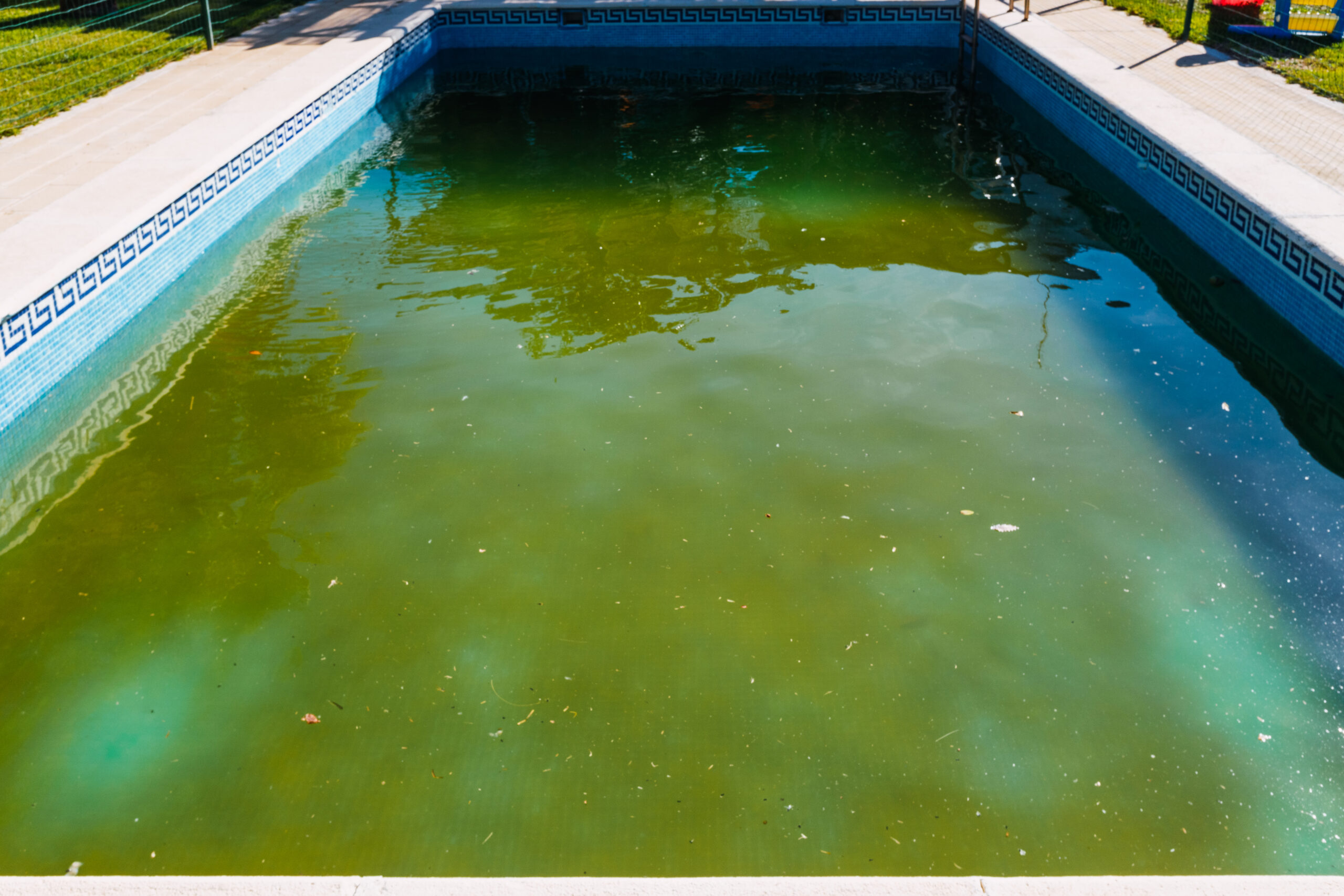
Quick answer: a green pool almost always means algae, and algae means your free chlorine dropped too low for your stabilizer level.
To clear it, test the water, bring pH to 7.2–7.5, then raise free chlorine to the shock level for your cyanuric acid (CYA) reading: about 40% of CYA, which is 12 ppm at CYA 30, 16 ppm at CYA 40 and 20 ppm at CYA 50. Hold that level by retesting and re-dosing at least three times a day, brush daily and run the pump 24 hours a day. A lightly green pool often turns blue-cloudy in 1–3 days; a dark green pool can take one to two weeks before it is fully clear.
This guide contains Amazon affiliate links. As an Amazon Associate, we earn from qualifying purchases, at no extra cost to you. Learn more.
Key takeaways
- Green water is almost always algae. The cause is chlorine that is too low relative to CYA, not “bad luck” or a single hot day.
- One bag of shock rarely fixes a green pool. You need to reach the shock level and keep it there until the algae is gone.
- Your CYA reading decides how much chlorine you need. Above roughly 70–90 ppm CYA, partially draining is usually cheaper than fighting it with chlorine.
- Use unstabilized chlorine (liquid chlorine or cal-hypo) for the cleanup. Trichlor and dichlor push CYA higher and make the problem harder.
- You are done when the water is clear, combined chlorine is 0.5 ppm or less, and the pool loses 1 ppm or less of chlorine overnight.
Why is my pool green? The four real causes
Algae spores blow into every outdoor pool all the time. They only take over when the free chlorine (FC) in the water is too weak to kill them faster than they grow. That happens for a few predictable reasons.
1. Free chlorine fell below the minimum for your CYA
This is the cause in most green pools. Cyanuric acid (stabilizer) protects chlorine from sunlight, but it also holds most of the chlorine in a weaker, bound form. The more CYA you have, the more FC you need to get the same algae-killing power. The CDC’s minimum for home pools is 1 ppm FC, rising to 2 ppm when you use CYA or stabilized chlorine products. In practice, a pool at CYA 50 needs a lot more than 2 ppm: the widely used Trouble Free Pool chlorine/CYA chart puts the minimum at 4 ppm and the target range at 6–8 ppm. If you have been holding “1–3 ppm” with tabs that keep adding stabilizer, algae is a matter of time. Our guide to cyanuric acid explains this relationship in detail.
2. A spike in chlorine demand
Sunlight, heat, heavy rain, a pool party, leaves and pollen all burn through chlorine. A pool that holds fine at 80°F can go green within 48 hours during a heat wave if no one adds chlorine. Rain also dilutes the water and can wash in fertilizer and phosphates.
3. Poor circulation or filtration
A pump that runs too few hours, a clogged filter, a closed return or a broken timer leaves dead spots where chlorine is not replenished. Algae usually appears first in corners, on steps, behind ladders and around the main drain for this reason.
4. It is not algae at all
If the water is clear but tinted green, or it turned green right after you shocked or added a copper-based algaecide, the cause may be dissolved metals (usually copper, sometimes iron) oxidized by chlorine. Orenda’s green-pool procedure recommends confirming the green is algae before you start. A simple check: fill a white bucket with pool water. Algae water looks cloudy or murky; metal-stained water looks clear but tinted, and the walls feel smooth rather than slimy. Metals need a sequestrant or metal remover, not more chlorine.
How green is it? Match the shade to the job
The shade tells you how much work is ahead and how long to expect. These are practical ranges, not guarantees; the real deciding factors are your CYA, your filter type and how consistently you hold the shock level.
| What you see | What it means | Typical time to clear |
|---|---|---|
| Slightly hazy, light green tint, slimy steps | Early algae bloom | 1–3 days |
| Teal or medium green, can still see the floor | Established bloom | 3–5 days |
| Dark green, cannot see the deep end | Heavy bloom | 5–10 days |
| Swamp: green-black, leaves on floor, smell | Neglected pool, high organic load | 1–2 weeks or more |
Trouble Free Pool’s SLAM guide says the process takes “a few days to a couple of weeks” depending on how much algae is present, and that the filter may need another week to polish the water after the algae dies. Sand filters are the slowest, DE the fastest and cartridge in between. If you are not sure what you are looking at, run the symptoms through our pool problem diagnostic.
Before you add chlorine: test three things
Skipping the test is how people pour in five bags of shock and still have a green pool. You need three numbers:
- CYA (stabilizer). This sets your shock target. If it is under 30 ppm, add stabilizer to reach 30. If it is above 70 ppm, Trouble Free Pool recommends draining and refilling enough water to get to 70 or lower before you start. At CYA 100 the shock level is 39 ppm, which is expensive to hold.
- pH. Get it to 7.2–7.5. The CDC notes chlorine kills germs less effectively above pH 8.0, and green pools often have very high pH. Orenda reports seeing pH above 10 in a neglected pool.
- Free chlorine. Your starting point, so you can calculate how much to add.
Use a liquid reagent kit with a FAS-DPD chlorine test if you can. The CDC says DPD tests can show a false low or even 0 ppm when chlorine is above 10 ppm, which is exactly where you will be during a cleanup. Strips also struggle to read high chlorine and CYA accurately. When pH is the problem, see how to raise or lower pool pH.
How to clear a green pool fast: step by step
This is the shock-and-hold method, called SLAM (Shock Level And Maintain) by Trouble Free Pool. Orenda’s procedure follows the same logic: lower pH, raise chlorine to 10–20 ppm with unstabilized chlorine, remove debris and filter hard.
- Clean out debris. Net leaves and sticks from the surface and floor. Piles of debris shield algae from chlorine and consume it. Empty the skimmer and pump baskets.
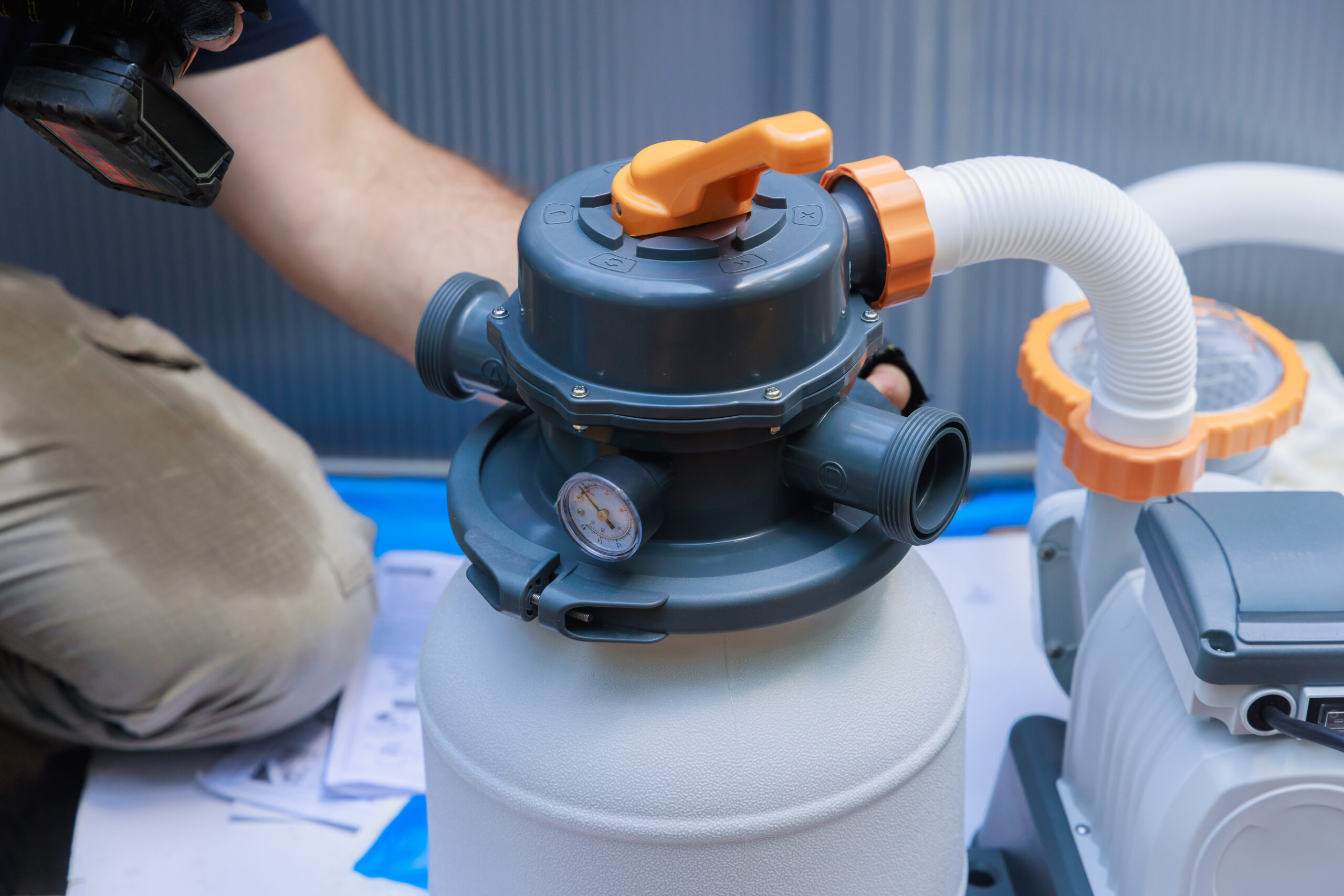
- Get the filter ready. Backwash a sand or DE filter, or hose off a cartridge. Make sure the pump is primed and all returns are open.
- Turn off other chlorine sources. Shut off a salt chlorine generator and remove tablets from floaters and inline feeders so you are not adding more CYA.
- Adjust pH to 7.2–7.5. Add acid (usually 31.45% muriatic acid) slowly into the deep end or in front of a return, following the label. Wait at least an hour with the pump running before you add chlorine. Never pour acid and chlorine at the same time or in the same spot.
- Raise free chlorine to your shock level. Find your CYA in the table below and dose with liquid chlorine around the perimeter, with the pump running. Use our pool calculator to get the exact amount for your pool volume and product strength.
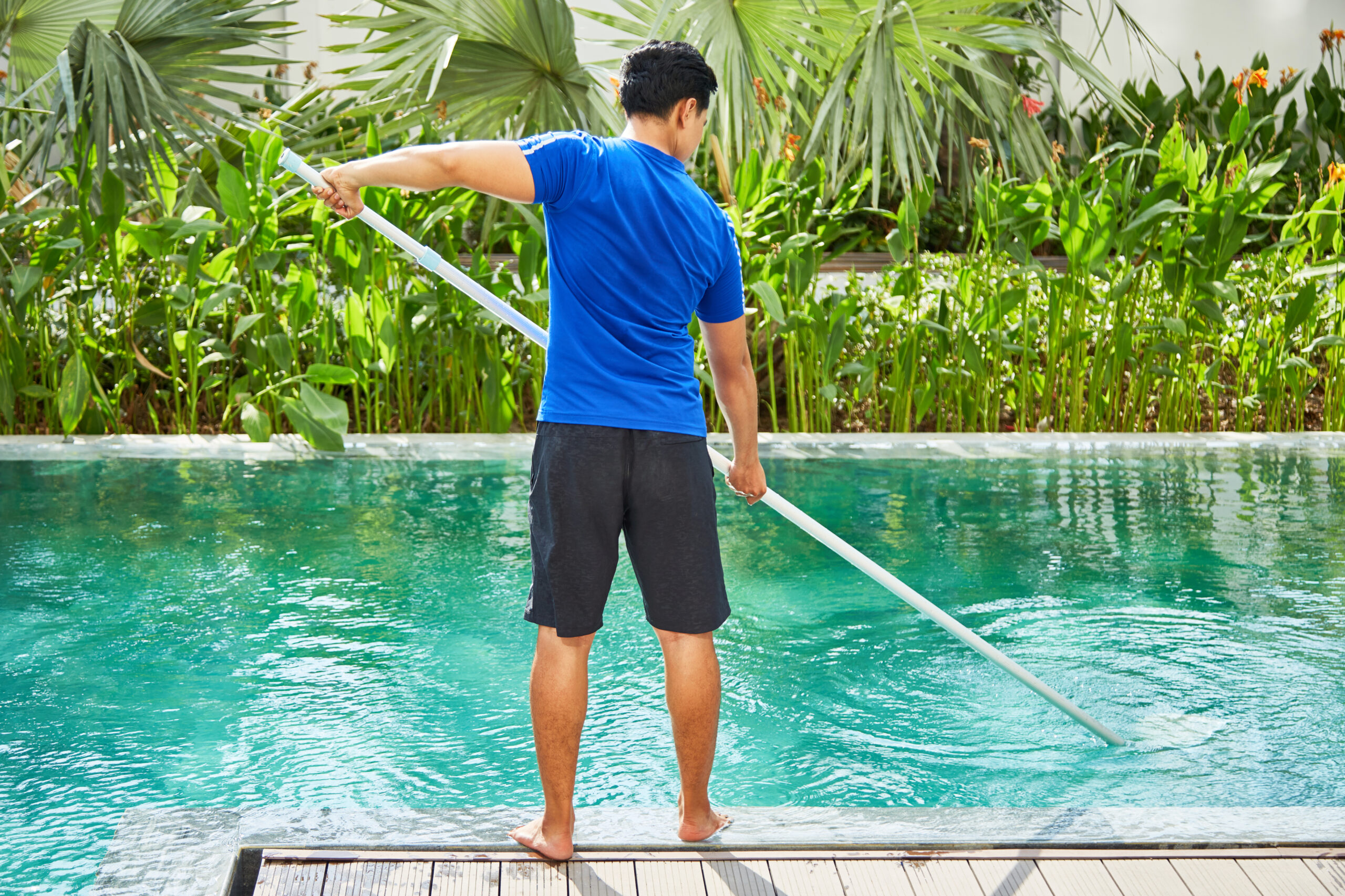
- Brush every surface. Walls, floor, steps, behind the ladder, inside the skimmer throat. Brushing breaks up the algae and exposes it to chlorine. Brush at least once a day for the whole process.
- Run the pump 24/7. Do not let the timer shut it off until the water is clear.
- Retest and re-dose at least three times a day. Morning, midday and night, top FC back up to the shock level. Algae will eat chlorine fast at first. If FC falls below the shock level for long, the algae regrows and you lose progress.
- Clean the filter as it loads up. Dead algae clogs filters quickly. Backwash or clean when pressure rises about 25% above your clean-filter reading.
- Vacuum the dead algae. When the water goes from green to blue-gray or cloudy white, vacuum the debris off the floor. Vacuum to waste on a sand or DE filter if you can, so the debris does not go back through the filter.
- Run the overnight test. Test FC right after sunset and again before sunrise. A loss of 1 ppm or less, combined chlorine of 0.5 ppm or less, and clear water with no visible algae mean you are done. Then let FC fall back to the normal target for your CYA.
Safety while you clean up
The CDC estimates pool chemical injuries send thousands of people to emergency rooms each year. Follow these rules every time:
- Never mix chemicals, and never mix acid with chlorine or one chlorine type with another. Add them separately, at different times.
- Always add chemical to water, never water to chemical.
- Wear goggles and chemical-resistant gloves, especially with muriatic acid.
- Keep children and pets away while you handle chemicals, and store products as the label says, with acid and chlorine apart.
- Do not swim until you can clearly see the main drain. If someone is exposed or swallows a chemical, call Poison Control at 1-800-222-1222, or 911 in an emergency.
For a deeper look at product types and the “how much shock” question in other situations, read how to shock a pool.
How much chlorine to clear a green pool
The shock target scales with CYA. These levels come from the Trouble Free Pool chlorine/CYA chart and work out to roughly 40% of your CYA reading.
| CYA (ppm) | Shock FC to hold (ppm) | Normal target FC after cleanup (ppm) |
|---|---|---|
| 20 | 10 | 3–5 |
| 30 | 12 | 4–6 |
| 40 | 16 | 5–7 |
| 50 | 20 | 6–8 |
| 60 | 24 | 7–9 |
| 70 | 28 | 8–10 |
| 80 | 31 | 9–11 |
| 100 | 39 | 11–13 |
Now convert that target into product. These figures are standard chemistry for 10,000 gallons; always check the strength printed on your product and follow the label.
| Product | Amount per 10,000 gal | Raises FC by about | Side effect |
|---|---|---|---|
| Liquid chlorine, 10% | 1 gallon | 10 ppm | Raises pH slightly, adds salt |
| Liquid chlorine, 12.5% | 1 gallon | 12.5 ppm | Raises pH slightly, adds salt |
| Cal-hypo, 73% | 1 lb | 8.7 ppm | Adds about 0.7 ppm calcium hardness per 1 ppm FC |
| Dichlor, about 56% | 1 lb | 6.7 ppm | Adds about 0.9 ppm CYA per 1 ppm FC (avoid for cleanup) |
Worked example: a 15,000-gallon pool at CYA 40 with FC at 1 ppm needs to reach 16 ppm, a jump of 15 ppm. One gallon of 10% chlorine raises 15,000 gallons by about 6.7 ppm, so the first dose is roughly 2.25 gallons. You will then add more two or three times a day to hold 16 ppm. Trouble Free Pool suggests having about 10 gallons of liquid chlorine on hand for pools under 20,000 gallons and 15 gallons for larger ones before you start.
Skip dichlor and trichlor here: adding 15 ppm FC with dichlor also adds about 13 ppm CYA. Cal-hypo works, but pre-dissolve it in a bucket of pool water (chemical into water, never the reverse) and watch calcium hardness.
Pool still green after shock? What is going wrong
- You did not reach or hold the shock level. A single dose that drops to 3 ppm by morning lets the algae recover. Test and re-dose through the day.
- CYA is too high. At CYA 80–100, a bag of shock barely registers. Test CYA first and partially drain if needed.
- pH is above 8. Chlorine is much less effective. Lower pH first.
- The filter is clogged or the pump is off. Check pressure and circulation.
- Hidden algae. Skimmer throats, light niches, ladder treads and the underside of steps reseed the pool. Brush them.
- It turned green after shocking. That points to metals, not algae.
When green turns to cloudy blue or white, that is progress: the algae is dead and the filter has to catch it. See how to clear cloudy pool water for that stage.
Green pool cleanup cost: DIY vs. hiring a pro
The DIY cost is mostly chlorine, plus acid, a test kit if you do not have one, and electricity for running the pump around the clock. For a 15,000-gallon pool at CYA 40, plan on several gallons of liquid chlorine over the first few days, and more for a dark green pool or high CYA.
Professional prices vary widely by region and how bad the pool is. As of November 2026, Thumbtack reports algae cleanup visits averaging about $156–$432, while full “green-to-clean” jobs on neglected pools commonly run several hundred to over a thousand dollars. Price rises with pool size, how dark the water is, the debris load, whether high CYA forces a partial drain, and the number of return visits.
DIY makes sense when you can test and dose three times a day for a week. Hire a pro if you cannot keep up that schedule, if the pool is a true swamp, or if the pump or filter is not working. Once the pool is clear, prevention is cheap: keep FC in the target range for your CYA, keep CYA around 30–50 ppm for a chlorine pool, run the pump long enough to turn the water over daily, and add extra chlorine before storms and heat waves. If you are replacing equipment, compare options in our filter guide.
Products worth a look
Widely sold, well-reviewed options that match the advice above. We have not tested them ourselves; check the label, size and compatibility with your pool or spa before you buy. Prices change often, so we don’t list them.
- Taylor K-2006C Service Complete FAS-DPD test kit: reads high chlorine and CYA accurately during a cleanup. Check price on Amazon
- Poolmaster 18-inch stainless steel algae brush: for scrubbing algae on plaster or gunite pools only, not vinyl. Check price on Amazon
Common mistakes to avoid
- Dumping in shock once and waiting. Holding the level is what kills the algae.
- Treating a green pool with tablets or dichlor, which keeps raising CYA.
- Ignoring CYA. If you never test it, you are guessing at your shock level.
- Shocking with pH above 8 and wondering why nothing happens.
- Relying on algaecide or flocculant instead of chlorine. Algaecides help prevent algae; they do not replace a proper shock.
- Turning the pump off at night to save power during a cleanup.
- Stopping too early because the water “looks blue.” Run the overnight chlorine loss test first.
Frequently asked questions
How long does it take to clear a green pool?
A lightly green pool often clears in 1–3 days if you hold the shock level. A dark green or neglected pool can take one to two weeks, plus extra filtering time to remove dead algae. Orenda says water on its procedure typically clears within about 24–36 hours, but that assumes aggressive debris removal and balanced water.
Can I swim in a green pool?
No. Algae signals that chlorine is too low to control germs, and murky water hides swimmers in trouble. Wait until you can clearly see the main drain and chlorine is back within a safe range for your stabilizer level.
Why did my pool turn green overnight?
Usually because chlorine ran out. Heat, heavy sun, rain or a crowd of swimmers can consume all of your free chlorine in a day, and algae can bloom within hours once FC hits zero. A clear green tint that appears right after shocking is more likely metals.
Do I need to drain a green pool?
Usually not. Draining is mainly needed when CYA is so high (above about 70–90 ppm) that holding the shock level is impractical. Partial draining is usually enough. Fully draining an inground pool can damage it in high groundwater areas, so get professional advice before emptying one.
Should I use algaecide on a green pool?
Chlorine does the heavy lifting. A non-copper algaecide can help prevent regrowth once the pool is clean, but follow the label exactly: algaecides are EPA-registered pesticides, and using them inconsistent with the label violates federal law. Copper-based algaecides can stain surfaces and turn blonde hair green.
Is it OK if the water turns cloudy after shocking?
Yes. Green to cloudy blue or white means the algae is dying. Keep holding the shock level, keep the pump running and clean the filter as pressure rises. The filter will clear the haze over the next few days.