Quick answer: keep cyanuric acid (pool stabilizer) at 30 to 50 ppm in an outdoor chlorine pool, 60 to 80 ppm in a saltwater pool, and never above 100 ppm.
Cyanuric acid protects chlorine from sunlight but also makes it weaker, so the higher your CYA, the more free chlorine you need. CYA does not break down or evaporate. The reliable way to lower it is to replace water: to cut CYA from 100 to 50 ppm, drain and refill about 50% of the pool.
This guide contains Amazon affiliate links. As an Amazon Associate, we earn from qualifying purchases, at no extra cost to you. Learn more.
- Cyanuric acid, CYA, stabilizer and conditioner are the same chemical. It also comes built into trichlor tablets and dichlor shock.
- Outdoor chlorine pools: 30 to 50 ppm. Saltwater pools: 60 to 80 ppm. Hot tubs: the CDC says don’t use it at all.
- Match free chlorine to CYA: a widely used rule is a minimum of 7.5% of your CYA reading, and 40% of it when you shock.
- Every 1 ppm of chlorine from trichlor adds about 0.6 ppm CYA; from dichlor, about 0.9 ppm. That’s why levels creep up all season.
- Percent of water to replace = 1 minus (target CYA ÷ current CYA). Enzyme reducers exist but results are inconsistent.
What cyanuric acid does in your pool
Free chlorine breaks down fast in direct sunlight. Cyanuric acid bonds loosely to chlorine and shields it from ultraviolet light. According to an ICC Building Safety Journal technical article, free chlorine lasts 3 to 4 times longer in an outdoor pool with CYA in the recommended range than in one without it. Without stabilizer, a sunny day can burn off most of your chlorine by mid-afternoon.
The trade-off is that chlorine bound to CYA isn’t actively killing anything. Only a small part of the free chlorine is in its active form (hypochlorous acid) at any moment. The CDC notes that disinfection times are longer when cyanuric acid is present, and for that reason it recommends at least 2 ppm free chlorine in home pools that use stabilizer, versus at least 1 ppm without it.
This is also why public health codes are rethinking CYA. A committee of the Council for the Model Aquatic Health Code proposed limiting the ratio of CYA to free chlorine to 20:1 (for example, 40 ppm CYA with 2 ppm free chlorine) instead of using a flat cap. The 2024 edition of the CDC’s Model Aquatic Health Code requires immediate remediation of public pools at 300 ppm CYA or higher. Your home pool doesn’t fall under the MAHC, but the logic is the same: too much stabilizer leaves you with chlorine that reads fine but works slowly.
Ideal cyanuric acid level by pool type
| Pool type | Target CYA | Maximum | Why |
|---|---|---|---|
| Outdoor pool, chlorine tablets or liquid chlorine | 30–50 ppm | 100 ppm | Enough sun protection without slowing chlorine too much |
| Outdoor saltwater (chlorine generator) pool | 60–80 ppm | 100 ppm | Generators produce chlorine slowly, so more protection helps |
| Indoor or fully shaded pool | Little or none | Per local code | Little UV to protect against |
| Hot tub or spa | None | None | The CDC advises against CYA in hot tubs |
The 30 to 50 ppm target and 100 ppm maximum appear in San Diego County’s pool operator guidance, and the ICC article cites 100 ppm as the APSP (now PHTA) maximum, with a partial drain and refill recommended above it. The 60 to 80 ppm range for salt pools comes from Trouble Free Pool’s chlorine/CYA chart. Your local health department may set different limits for public pools. For hot tubs, see our hot tub maintenance guide.
How much free chlorine you need at each CYA level
Because CYA ties up chlorine, a fixed chlorine target doesn’t work. Trouble Free Pool’s chart sets the minimum free chlorine at 7.5% of CYA and the shock level at 40% of CYA. Here’s what that means in practice:
| CYA (ppm) | Minimum free chlorine (ppm) | Shock level (ppm) |
|---|---|---|
| 20 | 2 (CDC minimum with stabilizer) | 8 |
| 30 | 2.3 | 12 |
| 40 | 3 | 16 |
| 50 | 3.8 | 20 |
| 60 | 4.5 | 24 |
| 80 | 6 | 32 |
| 100 | 7.5 | 40 |
Look at the bottom rows. At 100 ppm CYA, you need 7.5 ppm free chlorine just to stay safe, and killing algae takes 40 ppm. That’s why high stabilizer is one of the most common reasons a pool turns green even though “there’s chlorine in it.” If you’re fighting algae, start with our green pool guide and our step-by-step guide on how to shock a pool.
Why your CYA keeps going up
Cyanuric acid is a very stable molecule that doesn’t readily degrade in pools, according to the ICC article. It doesn’t evaporate and isn’t used up by chlorine. The only ways it leaves are splash-out, backwashing, draining, leaks and rain overflow.
Stabilized chlorine products keep adding it:
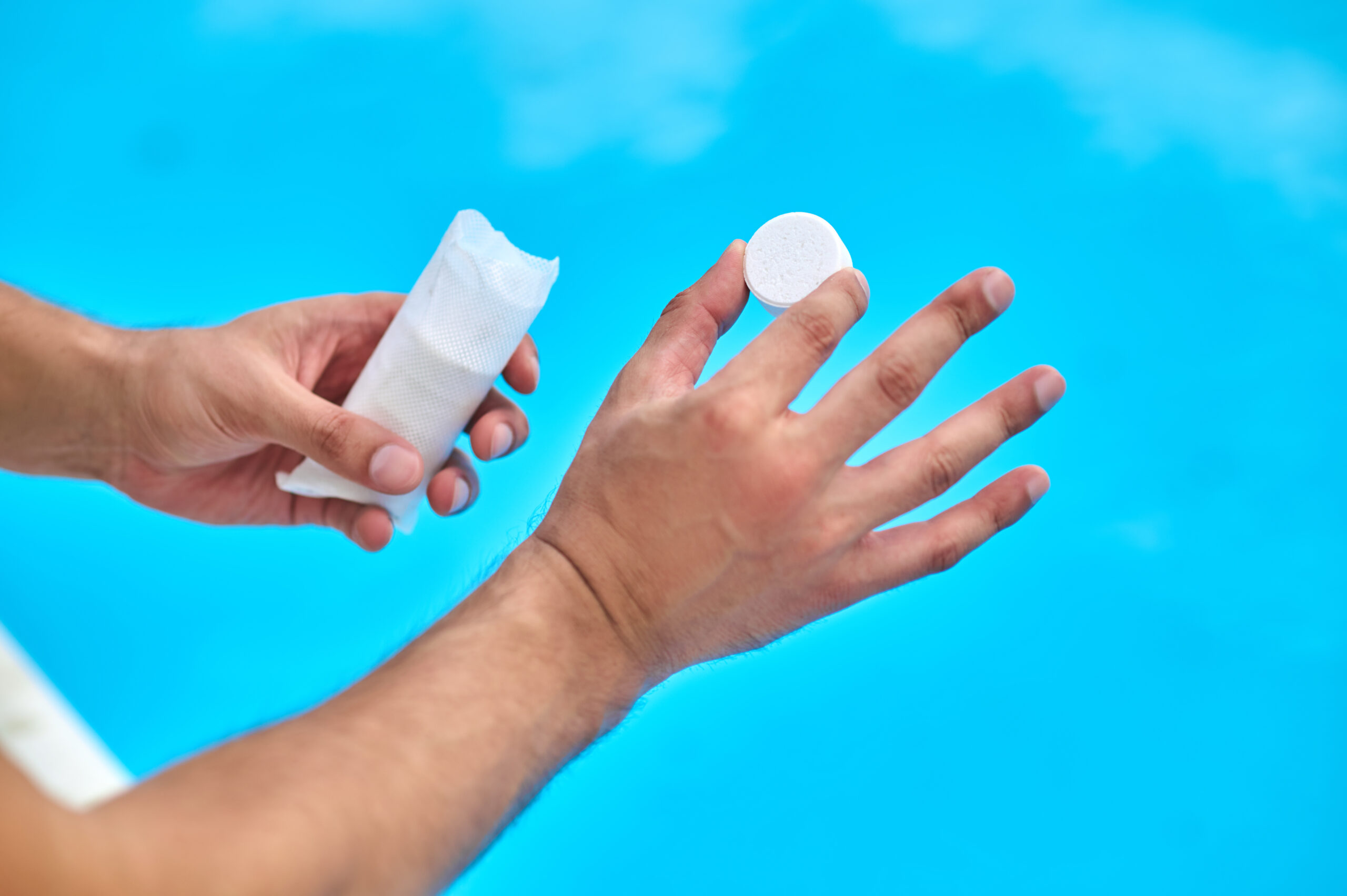
- Trichlor tablets or sticks add about 0.6 ppm CYA for every 1 ppm of chlorine they release (ICC Building Safety Journal).
- Dichlor granules add about 0.9 ppm CYA per 1 ppm chlorine (standard chemistry, based on dichlor’s formula).
Here’s the math for a typical summer: if your pool uses 3 ppm of chlorine a day and all of it comes from trichlor tablets, you add about 1.8 ppm of CYA a day, or roughly 50 ppm over a month. A pool that starts the season at 40 ppm can pass 100 ppm by midsummer. Liquid chlorine, cal-hypo and salt generators add no CYA at all.
How to test cyanuric acid
Most drop kits test CYA with a turbidity (cloudiness) test: you mix pool water with a reagent and look down a tube until a black dot disappears. Kits such as the Taylor K-2006 include it. Test strips have a CYA pad too, but they’re harder to read precisely.
- Test CYA at least monthly during the season, and before treating algae.
- Retest after adding stabilizer or partially draining.
- If a reading is above the top of your kit’s scale, mix the sample 50/50 with tap water (which has no CYA), test again and double the result.
- Follow your kit’s instructions for sample size and lighting; the reading depends on good light.
How to lower cyanuric acid
There’s no chemical you can add that simply neutralizes CYA. You have three realistic options.
1. Partial drain and refill (most reliable)
Fresh tap water has no cyanuric acid, so replacing water lowers CYA in direct proportion. Use this formula: fraction to replace = 1 − (target CYA ÷ current CYA).
| Current CYA | Target CYA | Water to replace | In a 15,000-gal pool |
|---|---|---|---|
| 80 ppm | 50 ppm | 38% | about 5,600 gal |
| 100 ppm | 50 ppm | 50% | about 7,500 gal |
| 120 ppm | 50 ppm | 58% | about 8,750 gal |
| 150 ppm | 50 ppm | 67% | about 10,000 gal |
| 200 ppm | 50 ppm | 75% | about 11,250 gal |
Two smaller drains are less efficient than one big one: two 30% drains remove about 51%, not 60%, because the second drain removes already-diluted water. Use our pool calculator to find your pool’s volume first.
- Test CYA with a drop kit and calculate how much to replace.
- Check your pool’s limits. Vinyl liners can shrink or shift if exposed, and inground pools can be damaged by groundwater pressure when drained low. If you need to drop the water more than about a third, or below the bottom of the shallow end, check your pool builder’s or liner maker’s guidance first.
- Drain with a submersible pump or your filter’s waste setting, to a spot your city allows. Many cities have rules on discharging chlorinated water; letting chlorine drop first helps.
- Refill with a garden hose right away, so walls and liner aren’t exposed for long.
- Circulate for several hours, retest CYA, free chlorine, pH, alkalinity and calcium, and rebalance. Fresh water will shift all of them.
- Switch chlorine sources so CYA doesn’t climb again: liquid chlorine, cal-hypo or a salt generator instead of only trichlor.
2. Cyanuric acid reducer (enzyme/microbial products)
Products like Bio-Active Cyanuric Acid Reducer use microbial cultures to break CYA down. The manufacturer’s technical sheet says it works best at water temperatures of 65°F to 105°F, that full effect won’t occur while chlorine is above 5 ppm, and that it works for up to 10 days, with the pump running at least 4 hours a day. User results are mixed, especially in cool water. If you try one, follow the label exactly, keep chlorine at normal levels (not shock levels), and retest CYA after the treatment period before deciding anything.
3. Reverse osmosis filtering
Some pool companies offer mobile reverse osmosis units that filter your water on site and return it with lower CYA, calcium and dissolved solids. It’s an option where water is expensive or draining is restricted. Availability and pricing vary by area, so get local quotes.
How to raise cyanuric acid
If CYA tests below 30 ppm in an outdoor pool (common after a fresh fill or a big drain), add granular stabilizer. Pure cyanuric acid at about 13 oz by weight raises 10,000 gallons by 10 ppm. That’s standard math: 10 ppm in 10,000 gallons is about 378 grams.
- Add it in a skimmer sock, a mesh bag hung in front of a return, or a bucket per the label. Granular CYA dissolves slowly, often over several days.
- Avoid backwashing or cleaning the filter for as long as the label says (many say about a week), or you’ll lose undissolved product.
- Add in small steps and retest after a week. It’s easy to add more and hard to remove it.
- Liquid stabilizer dissolves faster but costs more per ppm; dose by its label.
Cyanuric acid is mildly acidic and may lower pH and alkalinity slightly as it dissolves. Retest pH and adjust as needed; our pool chemistry guide lists all the target ranges.
Products worth a look
Widely sold, well-reviewed options that match the advice above. We have not tested them ourselves; check the label, size and compatibility with your pool or spa before you buy. Prices change often, so we don’t list them.
- Taylor K-2006C Complete Pool Water Test Kit: includes a cyanuric acid test plus FAS-DPD chlorine to match FC to CYA. Check price on Amazon
- Taylor R-0013-C Cyanuric Acid Reagent, 2 oz: refill for the CYA test in Taylor kits. Check price on Amazon
Common mistakes to avoid
- Using trichlor tablets as your only chlorine all season. It’s the fastest way to reach 100+ ppm CYA.
- Keeping the same chlorine target as CYA rises. 2 ppm free chlorine is fine at 20 to 30 ppm CYA, not at 80.
- Shocking with dichlor in a high-CYA pool. Each 10 ppm of chlorine from dichlor adds about 9 ppm more stabilizer.
- Adding stabilizer before testing. Many pools already have plenty from tablets.
- Draining a pool completely to fix CYA without checking groundwater and liner risks. A partial drain is usually enough.
- Putting stabilizer or trichlor in a hot tub. The CDC advises against CYA in hot tubs.
- Expecting “chlorine lock” to be fixed by more shock. At very high CYA, the fix is dilution, not more chlorine.
Frequently asked questions
Is pool stabilizer the same as cyanuric acid?
Yes. Stabilizer, conditioner, CYA and cyanuric acid are names for the same chemical. Some products sold as “sun shield” or “chlorine protector” are also cyanuric acid; check the active ingredient on the label.
Does cyanuric acid go away on its own?
Not in any useful amount. It stays until water leaves the pool through splash-out, backwashing, leaks, rain overflow or draining. Pools with a lot of rain overflow or frequent backwashing lose some; pools in dry climates often lose very little.
Is it safe to swim with high cyanuric acid?
CYA itself isn’t the main concern at typical pool levels. The risk is that chlorine works more slowly, so germs and algae survive longer. If CYA is high, raise free chlorine to match (see the table above) until you can lower CYA.
Do saltwater pools need cyanuric acid?
Yes, if they’re outdoors. A salt cell makes chlorine slowly, and sunlight destroys it quickly, so salt pools are usually kept at 60 to 80 ppm CYA. Check your generator’s manual, since some manufacturers list their own range.
How long does stabilizer take to dissolve?
Granular stabilizer often takes several days to fully dissolve and show up on a test. Wait about a week before retesting and adding more, and don’t backwash during that time unless the label says it’s fine.
Sources
- CDC: Home pool and hot tub water treatment and testing
- CDC: Model Aquatic Health Code, 2024 edition changes
- ICC Building Safety Journal: Trichlor and cyanuric acid in pools
- San Diego County Department of Environmental Health: Pool operator water chemistry guidelines
- Aquatics International: MAHC committee recommends CYA-to-chlorine ratio
- Bio-Active Cyanuric Acid Reducer technical data sheet
- Trouble Free Pool: Understanding the chlorine/CYA chart