Quick answer: acid plus aeration lowers alkalinity; baking soda raises it
Keep total alkalinity (TA) at 80–120 ppm, or 60–80 ppm if you use liquid chlorine or a salt system and your pH keeps rising. To lower TA, add muriatic acid until pH is about 7.0–7.2, then aerate until pH returns to 7.6 and repeat; about 26 fl oz of 31.45% muriatic acid removes 10 ppm of TA in 10,000 gallons. To raise TA, add 1.5 lb of baking soda per 10,000 gallons for every 10 ppm you need.
This guide contains Amazon affiliate links. As an Amazon Associate, we earn from qualifying purchases, at no extra cost to you. Learn more.
Key takeaways
- Total alkalinity is your water’s pH buffer. Too low and pH swings; too high and pH keeps climbing no matter how much acid you add.
- Baking soda (sodium bicarbonate) is the standard way to raise TA: 1.5 lb raises it about 10 ppm in 10,000 gallons.
- The only practical way to lower TA in place is acid. Aeration then brings pH back up without bringing TA back.
- Lowering TA takes days to weeks, not hours. Expect several acid-and-aerate cycles if you’re starting above 150 ppm.
- If your pool has cyanuric acid, part of your TA reading is actually CYA. Subtract about one-third of your CYA level to estimate the real carbonate alkalinity.
- Always adjust TA before pH.
What total alkalinity is and what level to aim for
Total alkalinity measures how much dissolved alkaline material, mainly bicarbonate, is in your water. Those bicarbonate ions soak up acid, which is why TA is described as a pH buffer. It’s reported in ppm “as calcium carbonate” even though it isn’t calcium.
There are two respected target ranges, and which one fits depends on how you sanitize:
| Source | Recommended TA | Best fit |
|---|---|---|
| Taylor Technologies | 80–120 ppm | General default; pools using trichlor tablets, which are acidic, often do best at the upper half |
| Trouble Free Pool | 60–80 ppm ideal (50–90 acceptable) | Liquid chlorine and salt water generator pools, where pH tends to rise |
The difference isn’t a disagreement about chemistry. Liquid chlorine, cal-hypo and salt cells all push pH up, and higher TA means more carbon dioxide available to outgas, so pH rises faster. Lower TA slows that drift. Trichlor tablets push pH down, so those pools benefit from more buffer. Pick the range that matches your sanitizer, then watch how stable your pH is over a week.
Alkalinity vs. pH: how they differ
pH tells you how acidic the water is right now. Alkalinity tells you how much acid it would take to change that. A useful picture: pH is the position of a car, alkalinity is the weight of the car. A heavy car (high TA) is hard to push, which is good when you want stability and bad when you’re trying to bring pH down. A light car (low TA) moves with every nudge, so rain, a tablet feeder or a slightly large acid dose can send pH far off target. That’s why the two are tested separately and why TA is set first. Any product that lowers one lowers the other to some degree; the trick is choosing the method that moves the one you care about most.
The cyanuric acid correction
Standard TA tests count cyanurate as alkalinity. At normal pool pH, roughly one-third of your CYA level shows up in the TA reading. So a pool testing at 100 ppm TA with 60 ppm CYA has about 80 ppm of actual carbonate alkalinity. This matters most when CYA is high; if yours is above 60–70 ppm, factor it in before you decide your TA is “too high.” Our guide to cyanuric acid covers CYA itself.
Signs your alkalinity is too high or too low
| Symptom | Low TA (under about 60 ppm) | High TA (over about 120–150 ppm) |
|---|---|---|
| pH behavior | Swings widely; crashes after rain or acid | Rises steadily; needs acid every day or two |
| Water | Usually clear, may feel harsh | Can turn cloudy, especially with high calcium |
| Surfaces | Etching of plaster, corrosion of metal when pH also drops | White scale on tile, heaters and salt cells |
| Fix | Baking soda | Acid and aeration |
What pushes TA up? Mostly what you add. Orenda, a pool chemical maker, notes that baking soda and soda ash raise it directly, that the byproducts of liquid chlorine and cal-hypo add alkalinity over time, and that pools using CO2 injection for pH control often see TA creep up. Fill water also matters: in many regions tap water arrives with high alkalinity, so heavy top-offs in summer can raise TA too.
How to lower alkalinity in a pool
Acid lowers both pH and TA. Aeration then drives off carbon dioxide, which raises pH but leaves TA where it is. Repeating that pair is the method Trouble Free Pool teaches, and it works because CO2 outgasses fastest when pH is low, roughly 7.0 to 7.4.
How much acid lowers TA
From basic chemistry, 10 ppm of TA in 10,000 gallons equals about 7.6 moles of acid. That works out to:
| Lower TA by | Muriatic acid 31.45% (per 10,000 gal) | Dry acid, sodium bisulfate 93% (per 10,000 gal) |
|---|---|---|
| 10 ppm | About 26 fl oz | About 2.1 lb |
| 20 ppm | About 51 fl oz | About 4.2 lb |
| 30 ppm | About 77 fl oz (0.6 gal) | About 6.3 lb |
| 50 ppm | About 128 fl oz (1 gal) | About 10.5 lb |
You won’t add a 50 ppm dose in one go; that would crash pH. Instead, you spread the total over several cycles, each one taking pH down to about 7.0–7.2. With TA around 150 ppm, dropping pH from 7.6 to 7.2 uses roughly the acid that removes 10 ppm of TA, so expect several cycles. Our pool calculator works out the acid for your volume.
Step by step: the acid and aeration method
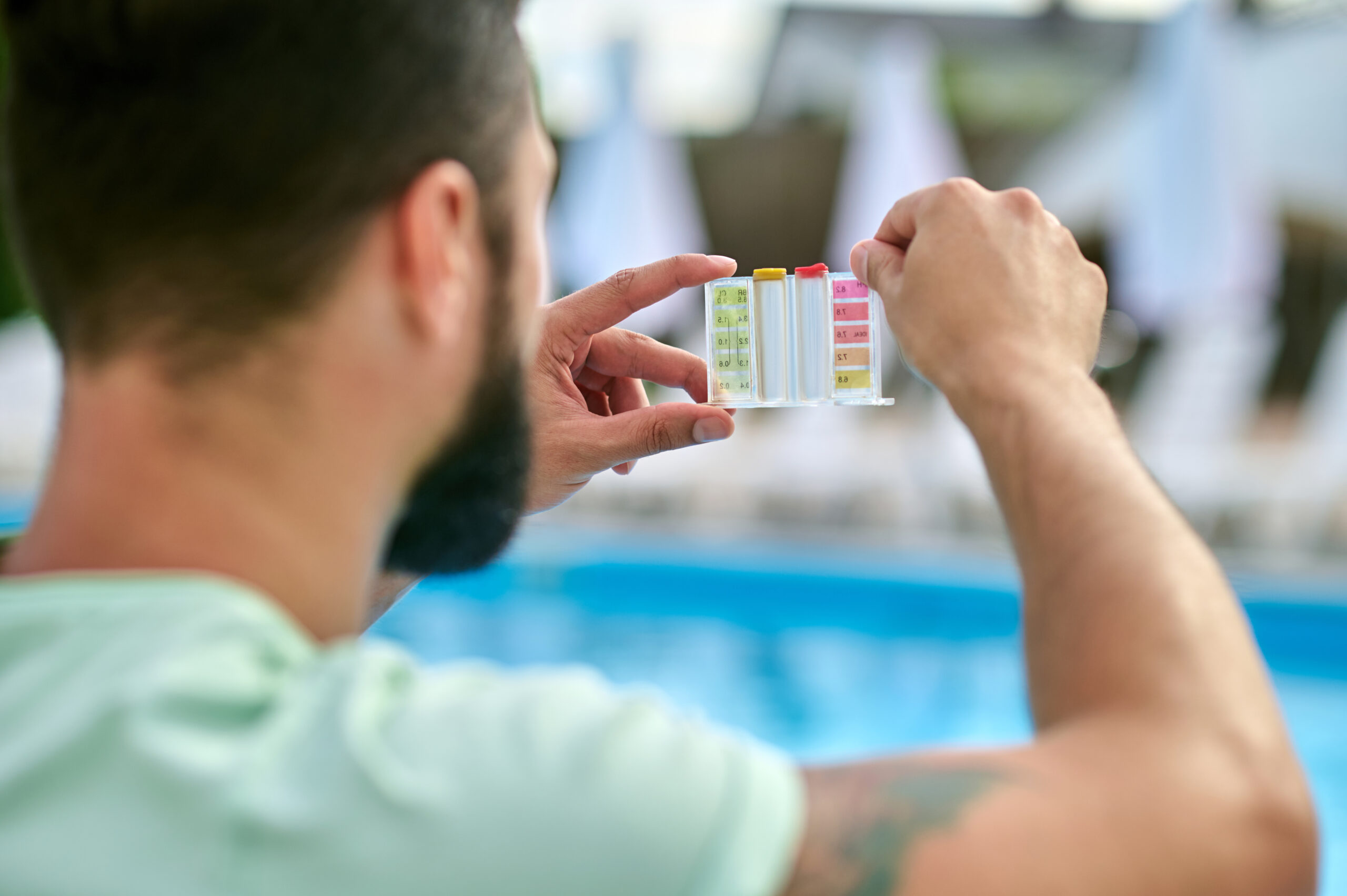
- Test TA, pH and CYA with a liquid kit, and decide your target TA.
- Put on goggles and gloves and turn on the pump.
- Add enough muriatic acid to bring pH to about 7.2. Trouble Free Pool’s method uses a 7.0–7.2 window; going lower adds little and is harder on vinyl liners and metal parts. Pour slowly in front of a return jet in the deep end.
- Circulate for at least 30 minutes, then retest pH. Swimming is best avoided until pH is back above 7.2.
- Aerate. Run waterfalls, fountains and spa spillovers, point return jets up so they break the surface, or run the spa jets with air valves open. A pool cover slows outgassing, so leave it off.
- When pH reaches about 7.6, retest TA. If it’s still above target, repeat from step 3.
- Stop when TA is at target, then let pH settle at 7.4–7.6.
Trouble Free Pool notes this can take days or even weeks, depending on how much aeration you have and how far TA has to fall. The same site reports members with 30,000-gallon pools lowering TA by about 10 ppm in 12 hours with strong aeration; a pool with only a skimmer and a single return will move more slowly.
What about the “pour in one spot” method?
Older advice says to pour acid in one concentrated spot with the pump off to lower TA more than pH. The chemistry doesn’t support it: once the water mixes, the same amount of acid removes the same amount of alkalinity no matter how you poured it. It also risks etching plaster or damaging a vinyl liner where the acid pools. Pour with the pump running.
How to raise alkalinity in a pool with baking soda
Pool “alkalinity increaser” is sodium bicarbonate, the same compound as grocery-store baking soda. Pool-labeled products are often sold in larger bags; either way, check that the label says 100% sodium bicarbonate. It raises TA strongly and pH only slightly, which is usually exactly what you want.
| Raise TA by | 5,000 gal | 10,000 gal | 20,000 gal |
|---|---|---|---|
| 10 ppm | 0.75 lb | 1.5 lb | 3 lb |
| 20 ppm | 1.5 lb | 3 lb | 6 lb |
| 30 ppm | 2.25 lb | 4.5 lb | 9 lb |
| 40 ppm | 3 lb | 6 lb | 12 lb |
Weigh the dose on a kitchen or bathroom scale rather than measuring by cups; the weight per cup varies with how packed the powder is.
Step by step: adding baking soda
- Test TA and pH. If TA is low and pH is also low, baking soda will help both.
- Turn on the pump.
- Weigh out your dose. For corrections over about 30 ppm, split it into two doses several hours apart.
- Broadcast it across the surface of the deep end, or dissolve it in a bucket of pool water first. Don’t dump it into the skimmer, where a large slug can cloud the water.
- Brush any powder that settles on the floor.
- Wait at least 6 hours, ideally overnight, then retest TA and pH.
If pH is fine but TA is low, use baking soda; if both are low, you can use baking soda first and finish with a little soda ash for pH. If only pH is low, see our guide to raising and lowering pH, since soda ash or aeration fits that case better.
Safety notes
- Never mix acid and chlorine. The CDC warns the combination releases toxic chlorine gas. Space acid and chlorine additions several hours apart and use separate containers.
- Add acid to water, never water to acid, and wear goggles and chemical-resistant gloves.
- Store acid upright, capped and away from chlorine, out of reach of children. Baking soda is low-risk but should still be kept dry and labeled.
- For eye or skin exposure, rinse with water for 15 minutes and call Poison Control at 1-800-222-1222; call 911 for breathing problems.
Products worth a look
Widely sold, well-reviewed options that match the advice above. We have not tested them ourselves; check the label, size and compatibility with your pool or spa before you buy. Prices change often, so we don’t list them.
- Taylor K-2006C Service Complete Pool Water Test Kit: drop-count alkalinity and CYA tests for accurate TA corrections. Check price on Amazon
Common mistakes to avoid
- Aerating at high pH. Aeration doesn’t lower TA, and it barely moves pH above about 7.6. Add acid first, then aerate.
- Expecting a one-day fix for high TA. Dropping from 180 to 80 ppm is a multi-day project.
- Ignoring CYA in the TA reading. With high stabilizer, your real carbonate alkalinity may already be in range.
- Using soda ash to raise TA. It works, but it spikes pH. Baking soda is the right tool.
- Chasing pH every day instead of lowering TA. If you add acid every couple of days, your TA is probably too high for your setup.
- Driving pH below 7.0 on a vinyl or metal-rich system. Low pH speeds corrosion and liner damage.
Frequently asked questions
Can I use regular baking soda in my pool?
Yes. Grocery-store baking soda is sodium bicarbonate, the same active ingredient as pool alkalinity increaser. Use 1.5 lb per 10,000 gallons for each 10 ppm. Large bags from a warehouse store or pool supplier are usually cheaper for big corrections.
Does baking soda raise pH?
Slightly. Sodium bicarbonate has a pH of about 8.3, so it nudges pool pH toward that point but rarely pushes it out of range. Soda ash, at about pH 11.3 in solution, raises pH far more.
How long does it take to lower alkalinity?
Each acid-and-aerate cycle takes about a day, depending on your aeration. Lowering TA by 50 ppm or more usually takes several days to a couple of weeks.
Is high alkalinity dangerous for swimmers?
Not directly. The problems are indirect: high pH that weakens chlorine, cloudy water and scale. Fix it, but there’s no need to close the pool unless pH or chlorine are out of range. If the water is cloudy, our guide to clearing cloudy pool water can help.
Should I adjust alkalinity or pH first?
Alkalinity first, because it controls how pH behaves. Our pool chemistry guide lays out the full order: TA, pH, calcium, stabilizer, chlorine.
Sources
- Taylor Technologies: Beginner’s guide to pool and spa water chemistry testing
- Trouble Free Pool: Ideal pool levels by sanitizer and surface
- Trouble Free Pool: How to lower total alkalinity
- Orenda: What causes high alkalinity in pools
- CDC: Home pool and hot tub water treatment and testing
- CDC: Use pool chemicals safely (poster)