Quick answer: test daily, clean weekly, deep-check monthly.
Every day, check free chlorine and pH (the CDC says at least twice a day when the pool is in use), empty the skimmer basket and run the pump long enough for one full turnover. Every week, brush and vacuum, run a full liquid test, adjust alkalinity and pH, and shock if combined chlorine is above 0.4 ppm. Every month, test calcium hardness and cyanuric acid, clean or backwash the filter when pressure is 8 to 10 psi above its clean reading, and inspect the drain covers, gate and equipment.
This guide contains Amazon affiliate links. As an Amazon Associate, we earn from qualifying purchases, at no extra cost to you. Learn more.
Key takeaways
- Chemistry is the daily job: keep free chlorine at 2 to 4 ppm and pH at 7.4 to 7.6 (Taylor Technologies’ residential ranges). The CDC’s floor is 1 ppm chlorine, or 2 ppm if you use stabilizer.
- Circulation is the cheapest cleaner you own. Run the pump for at least one full turnover per day; variable-speed pumps do it best on long, low-speed schedules.
- Brush walls and floor at least once a week, even with a robotic cleaner. Brushing breaks up algae before you can see it.
- Let the filter gauge tell you when to clean it. Backwashing or hosing a cartridge too often actually makes filtration worse.
- Calcium hardness and cyanuric acid move slowly, so test them monthly. Alkalinity weekly is enough for most pools.
- Safety is part of maintenance: check drain covers, gates and chemical storage every month.
Target levels to maintain
A maintenance schedule only works if you know what “good” looks like. These are the residential ranges Taylor Technologies, the largest US maker of pool test kits, publishes for chlorine pools. The CDC sets the health minimums in the last column. If your sanitizer’s EPA-registered label lists a different range, the label wins. For a full explanation of each number, see our pool water chemistry guide.
| Test | Target range | How often to test | CDC minimum |
|---|---|---|---|
| Free chlorine | 2.0–4.0 ppm | Daily (twice a day in heavy use) | 1 ppm; 2 ppm if stabilized |
| Combined chlorine | Under 0.4 ppm | Weekly | — |
| pH | 7.4–7.6 | Daily | 7.0–7.8 |
| Total alkalinity | 80–120 ppm | Weekly | — |
| Calcium hardness | 200–400 ppm | Monthly | — |
| Cyanuric acid (stabilizer) | 30–50 ppm | Monthly | — |
| Salt (salt pools only) | Per your chlorinator’s manual | Monthly | — |
Two notes on testing. First, the CDC says a DPD liquid kit is the most accurate home method and that strips are less accurate. Strips are fine for a quick daily check; use a liquid kit for the weekly full test. Second, if chlorine is above about 10 ppm (right after shocking, for example), the CDC warns the DPD test can bleach out and read falsely low or zero. Taylor’s FAS-DPD kits avoid that problem. Test at about the same time each day, ideally in the morning before sunlight burns off chlorine, so your readings are comparable.
Daily pool maintenance (5 to 10 minutes)
Daily tasks are short, but they are the ones that prevent green water. If you skip anything, do not skip chlorine.
- Test free chlorine and pH. Use a strip or a quick drop test. The CDC recommends testing at least twice a day and more often when many people are swimming. On a quiet pool, once a day is a realistic minimum.
- Top up chlorine. If free chlorine is under 2 ppm, add liquid chlorine in the evening so the sun does not destroy it before it works. With 12.5% liquid chlorine, about 10 fl oz raises free chlorine 1 ppm in 10,000 gallons (1 gallon of 12.5% adds roughly 12.5 ppm to 10,000 gallons). With 10% chlorine, use about 13 fl oz per ppm. Check the strength on the jug and use our pool chemical calculator for your exact volume.
- Skim the surface. A leaf net takes two minutes and removes leaves before they sink, stain plaster and feed algae.
- Empty the skimmer basket. A full basket chokes flow to the pump. Turn the pump off first if your skimmer has strong suction.
- Confirm the pump ran. Glance at the timer or controller and check that water is returning through the jets.
- Check the water level. It should sit about halfway up the skimmer opening. Too low and the pump can suck air; too high and the skimmer stops skimming.
How long to run the pump each day
Aim for at least one turnover per day, meaning all of the pool’s water passes through the filter once. The math is pool volume divided by flow rate. A 20,000-gallon pool on a pump moving 40 gallons per minute needs 20,000 ÷ 40 = 500 minutes, or about 8.3 hours. The Pacific Northwest National Laboratory’s building guide treats one turnover every 24 hours as the minimum filtration flow for residential pools.
If you have a variable-speed pump, run it longer at a lower speed rather than shorter at high speed. Pump power drops sharply as speed drops, which is why the US Department of Energy’s pool pump efficiency rule (in force since July 19, 2021) effectively pushed most new replacement pumps toward variable-speed designs. Use high speed only for tasks that need it, such as running a suction cleaner or vacuuming. You can split run time into blocks; two 4-hour runs filter the same water as one 8-hour run.
Weekly pool maintenance checklist (45 to 90 minutes)
Do the weekly routine on the same day every week. Clean first, then test, then add chemicals, so you are not measuring water full of stirred-up debris.
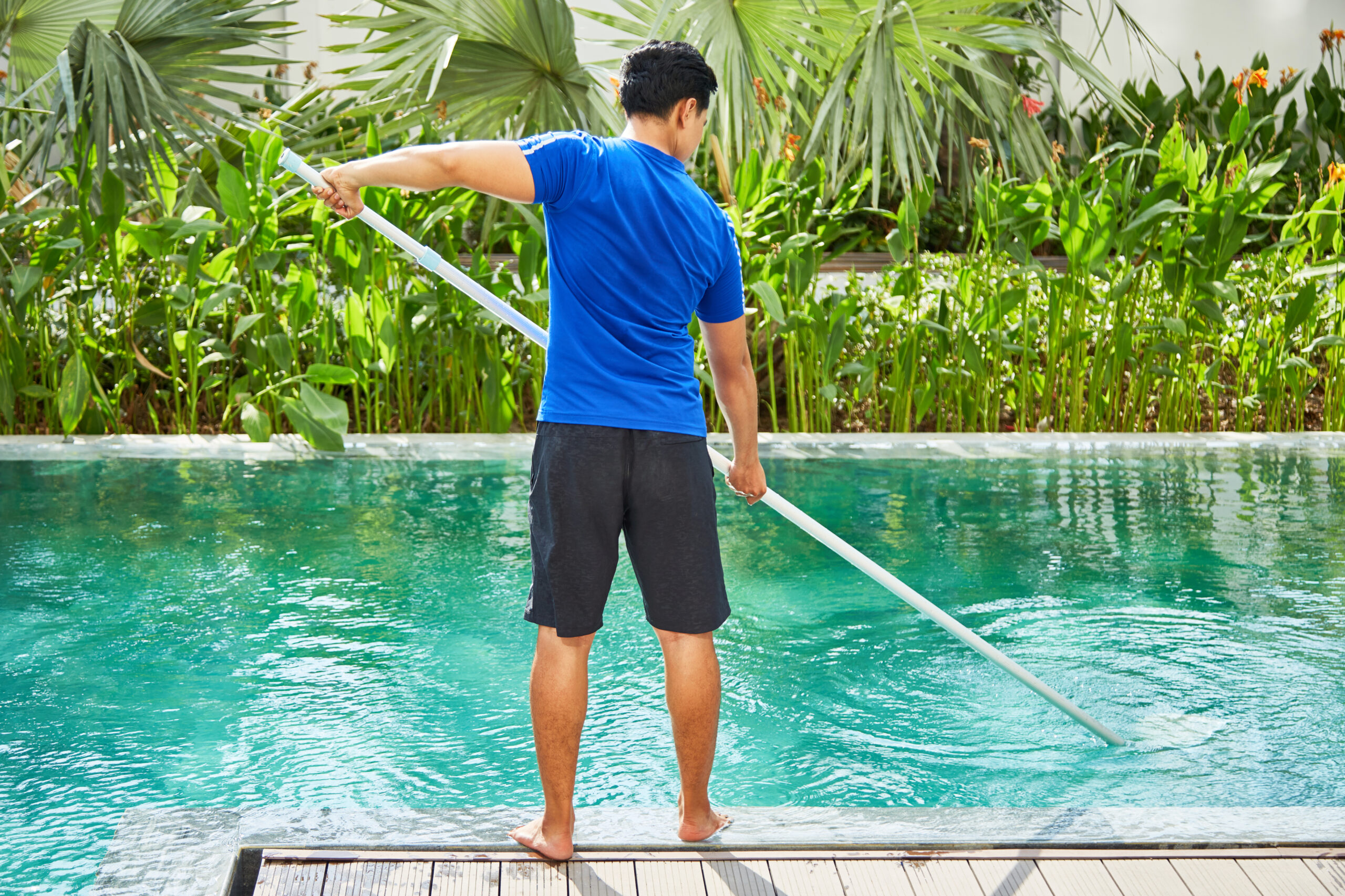
- Brush the walls, steps and floor. Work from the shallow end toward the main drain. Brush behind ladders, in corners and along the waterline, where circulation is weakest. Use a nylon brush on vinyl and fiberglass; save stainless-steel bristles for plaster and gunite.
- Vacuum. Let the debris you brushed settle for an hour, then vacuum manually or run your automatic cleaner. If you vacuum on the filter setting and the pressure jumps, that is your sign the filter will need cleaning soon.
- Empty the pump strainer basket. Turn the pump off, bleed the pressure at the filter’s air relief valve, open the lid, clean the basket, check the lid O-ring for cracks, and reseal. Replace any cracked basket; debris that slips through can jam the impeller.
- Brush the tile line. A soft tile brush or a pool-safe tile cleaner removes the oily ring of sunscreen and body oils before it hardens into scale.
- Run a full liquid test. Free and combined chlorine, pH and total alkalinity. Write the numbers down.
- Adjust alkalinity first, then pH. Alkalinity buffers pH, so fix it first. To raise it, 1.5 lb of baking soda (sodium bicarbonate) raises total alkalinity about 10 ppm in 10,000 gallons. To lower pH or alkalinity, use muriatic acid or dry acid as directed in our guides to raising and lowering pH and adjusting total alkalinity. Wait at least a few hours with the pump running between chemicals.
- Shock when the numbers say so. Shock if combined chlorine is above 0.4 ppm, after a pool party or heavy rain, or if the water looks dull. Many pools on a steady chlorine routine do not need a scheduled weekly shock. Our guide to how to shock a pool covers doses by product type.
- Check the filter pressure gauge. Note the reading against your clean baseline. You will act on it in the monthly routine, or sooner if it climbs fast.
Monthly pool maintenance tasks
- Test calcium hardness and cyanuric acid. Both change slowly, but both drift in the wrong direction over a season. Cyanuric acid climbs every time you use trichlor tabs or dichlor shock, and high levels make chlorine weaker. See our cyanuric acid guide for what to do when it passes 50 to 80 ppm.
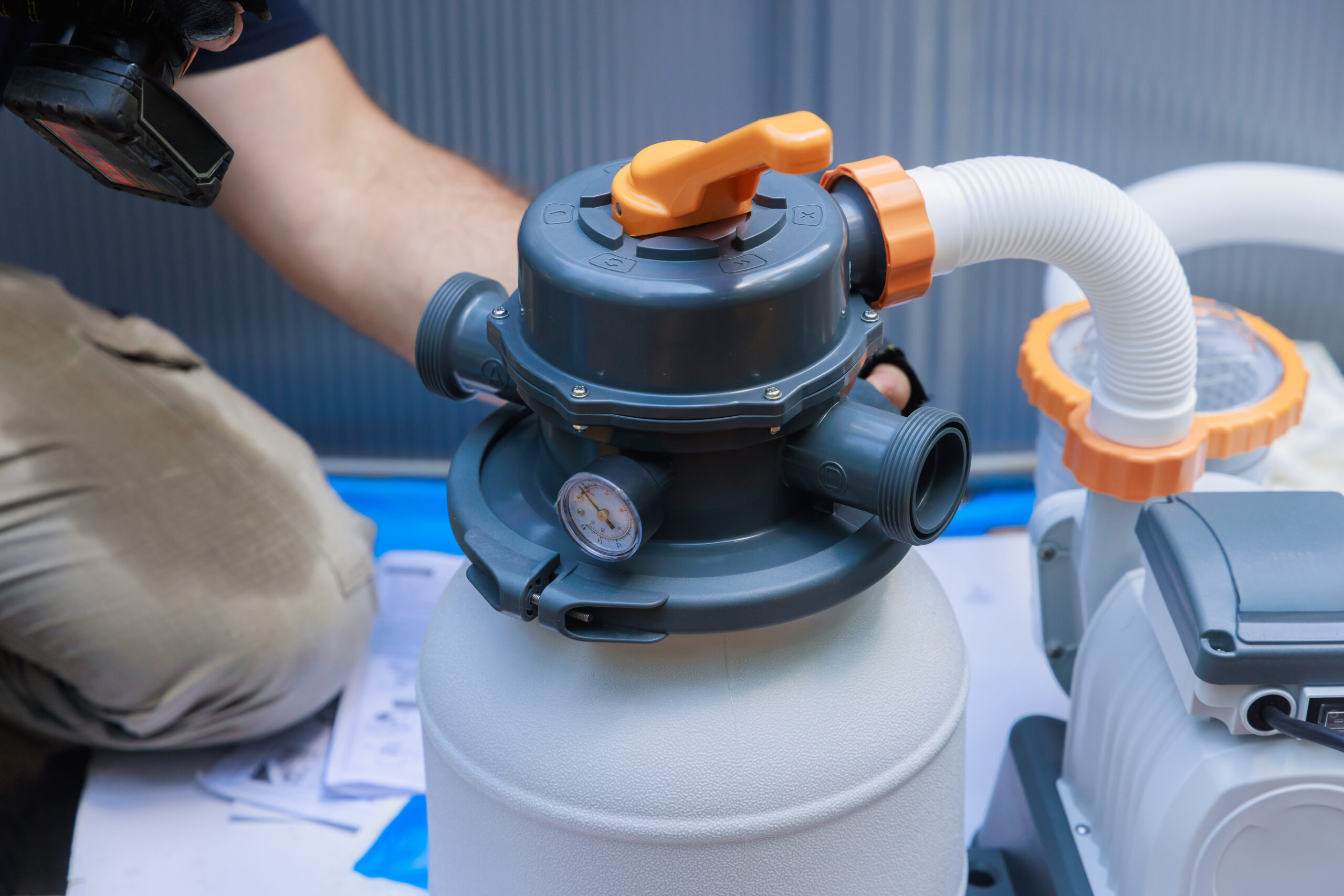
- Clean the filter when the gauge says so. Hayward and Pentair both tell owners to backwash or clean the filter when pressure rises 8 to 10 psi above the clean starting pressure. Write your clean pressure on a piece of tape on the tank so you never have to guess.
- Test salt (salt pools only). Use the range in your chlorinator’s manual. Inspect the salt cell for white scale and clean it only as the manufacturer directs.
- Inspect equipment. Look for drips at pump unions and the filter lid, listen for a pump that grinds or screams (often bearings), and check that the heater and timer settings are correct.
- Inspect safety gear. Pool Safely, the CPSC’s drowning-prevention campaign, says never to use a pool or spa with a loose, broken or missing drain cover. Check that gates are self-closing and self-latching, open outward from the pool, and that nothing near the fence lets a child climb over.
- Check chemical storage. The EPA warns that common pool chemicals are incompatible with each other. Keep acid and chlorine apart, store containers closed and upright in their original packaging, do not stack them, and keep them locked away from children, pets, gasoline and mowers.
Seasonal and yearly maintenance
| When | Task | Why it matters |
|---|---|---|
| Spring (opening) | Remove cover, reconnect equipment, fill to mid-skimmer, run a full test and shock | Starts the season with clean water and a working filter |
| Start of summer | Increase test frequency and pump run time | Heat, sun and swimmers burn chlorine faster |
| Mid-season | Deep-clean the filter (degrease cartridges or DE grids) | Oils build up that a hose or backwash will not remove |
| After storms | Skim, empty baskets, test and shock as needed | Rain dilutes chemicals and washes in debris and phosphates |
| Fall (closing) | Balance water, lower level as needed, blow out lines in freezing climates, cover | Prevents freeze damage and a green spring opening |
| Yearly | Inspect drain covers for expiry dates, pump seals, heater, and electrical bonding | Catches failing parts before they become expensive |
If you live in the Sun Belt and swim year-round, there is no closing. Instead, cut pump time and chlorine demand in the cooler months, but keep testing at least twice a week. Water that sits warm and unchlorinated for two weeks will turn green in any season.
Any electrical work on pumps, heaters, lights or bonding belongs to a licensed electrician. Pool water and household current are a lethal combination.
How to read your maintenance log
A simple log (date, free chlorine, pH, alkalinity, filter pressure, chemicals added, weather) turns guesswork into patterns. Here is what common patterns mean:
- Chlorine drops to zero overnight. Something is eating it: early algae, a heavy organic load, or very low stabilizer in a sunny pool. Run an overnight chlorine loss test: test at dusk and again at dawn. Losing more than 1 ppm overnight points to algae or organics.
- pH climbs every week. Usually high alkalinity, a salt chlorinator, liquid chlorine, or aeration from waterfalls and spillovers. Lower alkalinity toward 80 ppm and pH will drift more slowly.
- pH falls every week. Common with trichlor tablets, which are acidic. Raise alkalinity with baking soda and watch cyanuric acid.
- Filter pressure rises within days. The filter is catching a lot: dead algae, pollen, or a new fill. If it rises fast and water stays hazy, look for algae or a chemistry problem before blaming the filter.
Not sure what a symptom means? Our pool problem diagnostic tool walks through causes by symptom.
Pool maintenance cost: DIY vs. hiring a service
Doing it yourself costs mostly chemicals, a test kit, brushes, filter media and electricity. A good liquid test kit is a one-time purchase plus reagent refills, and it pays for itself by preventing over-dosing.
Hiring out is the alternative. As of November 2026, HomeGuide puts routine monthly pool maintenance at roughly $80 to $150 per month, with an average near $122, and Angi’s most recent figures fall in the same $80 to $150 range for cleaning and water testing. Opening and closing are usually billed separately: HomeGuide lists opening at about $350 to $500 and closing at about $300 to $650. What drives the price:
- Chemicals included or not. “Chemicals included” plans cost more but cap your spending.
- Pool size and debris. Big pools under trees take longer every visit.
- Service frequency. Weekly is standard; twice a week costs more.
- Extras. Filter cleaning, salt cell cleaning and green-pool recovery are usually add-ons.
- Location. Prices run higher in metro areas and year-round pool markets.
A common middle path: do the daily checks yourself and hire a pro only for opening, closing and filter deep-cleans. Get two or three local quotes, and ask exactly which tasks and chemicals each visit includes.
Products worth a look
Widely sold, well-reviewed options that match the advice above. We have not tested them ourselves; check the label, size and compatibility with your pool or spa before you buy. Prices change often, so we don’t list them.
- Taylor K-2006C Service Complete Pool Water Test Kit: FAS-DPD liquid kit for the weekly full test, including chlorine, pH, alkalinity, hardness and CYA. Check price on Amazon
- Taylor K-2006-SALT Saltwater Pool Test Kit: same tests plus salt for saltwater pools. Check price on Amazon
- Poolmaster 18-Inch Stainless Steel Algae Brush: weekly brushing on plaster and gunite pools only, not vinyl or fiberglass. Check price on Amazon
Common mistakes to avoid
- Testing only when the water looks bad. By the time water is cloudy or green, chlorine has been low for a day or more.
- Mixing chemicals. Never mix acid and chlorine, or two kinds of chlorine (for example cal-hypo and trichlor), even in a bucket or a skimmer. Add each chemical to the pool water separately, never water to chemical, with the pump running. Wear goggles and gloves for acid.
- Putting shock or tablets in the skimmer. Concentrated chlorine in the plumbing can damage equipment, and some combinations can react violently.
- Cleaning the filter too often. A slightly dirty filter traps finer particles. Wait for the 8 to 10 psi rise.
- Relying on a robotic cleaner instead of brushing. Cleaners miss steps, corners and the waterline.
- Ignoring stabilizer creep. Years of trichlor tabs can push cyanuric acid past 100 ppm, where chlorine struggles to kill algae.
- Guessing pool volume. Every dose depends on it. Measure once and use the calculator.
Frequently asked questions
What is the minimum weekly pool maintenance?
At a bare minimum: keep chlorine in range every day, empty the skimmer and pump baskets, brush and vacuum once a week, and run one full liquid test with pH and alkalinity adjustments. Everything else can follow a monthly schedule.
How often should you shock a pool?
Shock when combined chlorine is above 0.4 ppm, after heavy use or storms, or when you see early algae. Many owners shock weekly as a habit, which is reasonable in hot, busy pools, but a pool that holds steady free chlorine with low combined chlorine does not need it every week.
How often should you clean a pool filter?
Go by pressure, not the calendar. Hayward and Pentair both say to clean or backwash when the gauge reads 8 to 10 psi above the clean starting pressure. Cartridge and DE filters also benefit from a chemical deep-clean once or twice a season.
Should the pool pump run 24 hours a day?
Not usually. One turnover per day is the standard minimum. A variable-speed pump on low speed can run 12 to 24 hours cheaply, and longer low-speed runs improve skimming. A single-speed pump should run only as long as one turnover takes, since it uses the same high power the whole time.
Does an above ground pool need the same maintenance?
Yes. The chemistry targets are the same. Smaller volume means chemicals swing faster, so test at least as often and dose carefully. Use soft-bristle brushes on vinyl walls, and check the liner and wall for bulges or leaks during the monthly inspection.
What should I do if someone swallows or inhales pool chemicals?
Call Poison Control at 1-800-222-1222 right away. If the person has trouble breathing, collapses or has a seizure, call 911.
Sources
- CDC: Home pool and hot tub water treatment and testing
- Taylor Technologies: Beginner’s guide to pool and spa water chemistry testing
- Hayward: Why a filter runs at high pressure (8–10 psi rule)
- Pentair: Clean & Clear cartridge filter support
- PNNL Building America Solution Center: Variable-speed pool pumps
- CPSC Pool Safely: Barrier checklist for pool and spa owners
- EPA: Safe storage and handling of swimming pool chemicals
- HomeGuide: Pool maintenance cost