Quick answer: to shock a pool, raise free chlorine to about 10 times your combined chlorine reading (or higher if algae is present), at dusk, with the pump running and pH at 7.2 to 7.6.
In a 10,000-gallon pool, 1 gallon of 12.5% liquid chlorine raises free chlorine by about 12.5 ppm, and 1 lb of 73% calcium hypochlorite raises it by about 8.7 ppm. Shock after heavy use, heavy rain, cloudy water, algae, or whenever combined chlorine reaches 0.5 ppm. Swim again only once free chlorine is back in your normal range and the product label allows it.
This guide contains Amazon affiliate links. As an Amazon Associate, we earn from qualifying purchases, at no extra cost to you. Learn more.
- “Shock” is a dose, not a product: any chlorine can shock a pool if you add enough of it. Liquid chlorine, cal-hypo and dichlor all work; non-chlorine shock (MPS) oxidizes but does not sanitize.
- Test first with a DPD kit that reads free and total chlorine. Combined chlorine = total chlorine minus free chlorine. The breakpoint target is 10 times combined chlorine.
- Stabilizer (cyanuric acid) slows chlorine down, so pools with CYA need a higher shock level. A common rule of thumb is free chlorine at 40% of your CYA reading.
- Each shock type leaves something behind: cal-hypo adds calcium, dichlor adds stabilizer, liquid chlorine adds only salt.
- Never mix chlorine products with each other or with acid. Add each chemical to the pool separately, with the pump running.
What shocking a pool actually does
Shocking (also called superchlorination or breakpoint chlorination) means adding a large enough dose of oxidizer to burn off the waste that normal chlorine levels can’t keep up with. That waste includes sweat, urine, sunscreen, body oils, leaves and algae.
When chlorine reacts with nitrogen-based waste, it forms chloramines, also called combined chlorine. The Indiana Department of Health’s breakpoint guidance notes that chloramines are 40 to 60 times less effective as disinfectants than free chlorine. They’re also what causes the “chlorine smell,” red eyes and irritated skin people blame on too much chlorine. A strong smell usually means too little free chlorine, not too much.
A shock dose pushes chlorine past the “breakpoint,” the point where it has enough strength to destroy the chloramines and other contaminants. Below that point you can make things worse: a partial dose creates more chloramines instead of clearing them. That’s why the size of the dose matters more than the brand of shock you buy.
For context on everyday levels, the CDC recommends keeping home pools at pH 7.0 to 7.8 with at least 1 ppm free chlorine, or at least 2 ppm if you use stabilizer or stabilized chlorine (dichlor or trichlor). See our pool water chemistry guide for all the target ranges.
When to shock your pool
You don’t need to shock on a fixed calendar if your free chlorine never drops and combined chlorine stays at zero. Most residential pools, though, need it in these situations:
- Combined chlorine at 0.5 ppm or higher. Indiana’s public pool rule requires superchlorination at 0.5 ppm combined chlorine, and its health staff recommend doing it at 0.2 ppm. That’s a good trigger for a home pool too.
- After heavy use. A pool party, a week of kids swimming every day, or a lot of sunscreen in the water.
- After heavy rain or a storm. Rain dilutes chlorine and washes in debris, pollen and fertilizer.
- Cloudy or green water. Algae and cloudiness mean chlorine has lost the battle. See why your pool is green for the full algae process.
- Opening the pool after winter.
- A fecal accident or vomit in the water (see the CDC-based levels below).
Best time of day: shock at dusk or in the evening. Sunlight breaks down unstabilized chlorine quickly, so a midday dose loses a large part of its strength before it does its job. Running the pump overnight spreads the chlorine through the whole pool.
How much shock to add
The right dose depends on why you’re shocking. Use the level that matches your situation:
- Routine shock or chloramine smell: raise free chlorine to 10 times your combined chlorine. This is the breakpoint formula health departments use. If combined chlorine is 0.6 ppm, your target free chlorine is 6 ppm.
- Pools with stabilizer, or algae: cyanuric acid holds chlorine in reserve, so the effective dose is lower than the reading suggests. Trouble Free Pool’s widely used chlorine/CYA chart sets the shock level at 40% of the CYA reading. At 30 ppm CYA that’s 12 ppm free chlorine; at 50 ppm CYA it’s 20 ppm. You hold that level until the water clears and the overnight chlorine loss is 1 ppm or less.
- Formed stool or vomit: CDC-based contamination guidance (as published by the New York State Department of Health) calls for 2 ppm free chlorine for 25 to 30 minutes at pH 7.5 or lower, and double the time if the water contains cyanuric acid.
- Diarrhea: the same guidance calls for 20 ppm free chlorine for 12 hours 45 minutes at pH 7.5 or lower, in water without stabilizer. Stabilized water needs far longer, so some health departments recommend lowering CYA or draining instead.
Next, work out how many ppm you need to add: target level minus your current free chlorine. Then use the table below or our pool chemical calculator to turn that into gallons or pounds for your pool size.
Shock dosing table (per 10,000 gallons)
These figures are standard chemistry based on the product’s available chlorine. Always check your product’s label, because strength varies by brand and liquid chlorine loses strength as it ages.
| Product (strength) | Amount per 10,000 gal | Raises free chlorine by | Also adds |
|---|---|---|---|
| Liquid chlorine, 12.5% sodium hypochlorite | 1 gallon (about 10 fl oz per 1 ppm) | about 12.5 ppm | Salt only; small temporary pH rise |
| Liquid chlorine, 10% | 1 gallon (about 13 fl oz per 1 ppm) | about 10 ppm | Salt only |
| Calcium hypochlorite (cal-hypo), 73% | 1 lb (about 1.8 oz per 1 ppm) | about 8.7 ppm | About 0.7 ppm calcium hardness per 1 ppm chlorine; raises pH |
| Calcium hypochlorite, 65% | 1 lb (about 2 oz per 1 ppm) | about 7.8 ppm | Calcium; raises pH |
| Sodium dichlor, 56% | 1 lb | about 6.7 ppm | About 0.9 ppm cyanuric acid per 1 ppm chlorine |
| Potassium monopersulfate (non-chlorine shock) | Per label, commonly 1 lb | 0 ppm (not a sanitizer) | Oxidizes waste only |
The cal-hypo figures line up with the Indiana Department of Health’s worked example, which uses a 67% product rated at 2 oz per 1 ppm in 10,000 gallons. For pool sizes other than 10,000 gallons, multiply by your volume divided by 10,000.
Worked example
Your 15,000-gallon pool tests at 1.5 ppm free chlorine and 2.5 ppm total chlorine. Combined chlorine is 2.5 minus 1.5, or 1.0 ppm. The breakpoint target is 10 times that, or 10 ppm free chlorine. You need to add 10 minus 1.5 = 8.5 ppm.
- With 12.5% liquid chlorine: 8.5 ppm × 1.5 (for 15,000 gallons) × about 10 fl oz = roughly 130 fl oz, or just over 1 gallon.
- With 73% cal-hypo: 8.5 ppm × 1.5 ÷ 8.7 ppm per lb = about 1.5 lb (24 oz).
Which type of pool shock to use
All chlorine shocks kill germs and algae. The real difference is what they leave in your water after the chlorine is used up. Pick based on your current test results.
| Type | Best for | Avoid when | Notes |
|---|---|---|---|
| Liquid chlorine (sodium hypochlorite) | Most pools; large doses for algae; vinyl liners | You need a dry product to store long-term | Loses strength in heat and over weeks; buy fresh |
| Cal-hypo (calcium hypochlorite) | Pools with low calcium; plaster pools | Calcium hardness is already high; hard-water areas | Pre-dissolve if your label says so; can bleach vinyl if granules settle |
| Dichlor | Small top-ups; new water with zero CYA | CYA is already 50 ppm or higher | Raises stabilizer every time you use it |
| Non-chlorine shock (MPS) | Oxidizing swimmer waste with fast re-entry | Algae, cloudy water, fecal accidents | Does not sanitize; can read as combined chlorine on DPD tests |
Liquid chlorine vs. shock: bagged “shock” is not stronger than liquid chlorine, it’s just a different form of chlorine. Liquid chlorine is the cleanest choice for big doses because it doesn’t add calcium or stabilizer. If you use a lot of dichlor shock, track your stabilizer level; our cyanuric acid guide explains why high CYA makes chlorine weaker and how to bring it down.
If you use non-chlorine shock, note that potassium monopersulfate interferes with the DPD total chlorine test and can make combined chlorine look higher than it is. Taylor sells a separate reagent for this, but most homeowners can simply avoid testing for a day after an MPS dose.
How to shock a pool: step by step
- Test the water. Measure free chlorine, total chlorine, pH and cyanuric acid. A DPD or FAS-DPD drop kit is more accurate than strips, and the CDC notes that strips and DPD tests can bleach out and read falsely low or zero above 10 ppm.
- Adjust pH first. Bring pH to 7.2 to 7.6. Chlorine works much better at the lower end of the range. If pH needs changing, do it at least a few hours before you shock, and never add acid and chlorine at the same time. Our pH guide covers the doses.
- Calculate the dose using the target level that fits your situation and the table above, or the calculator.
- Put on goggles and chemical-resistant gloves. Keep children and pets away from the pool and the chemicals.
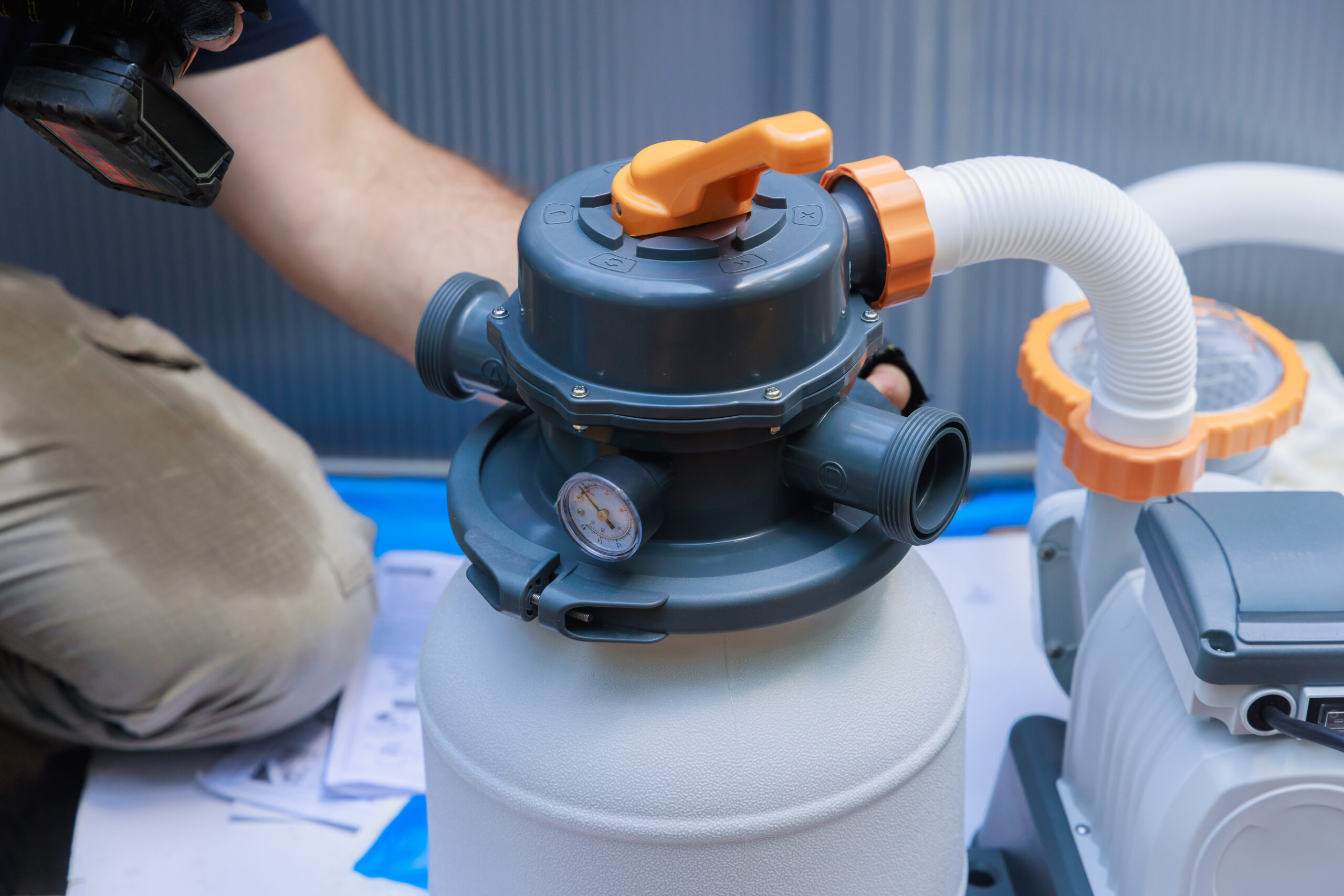
- Run the pump. Circulation must be on before, during and for several hours after the dose.
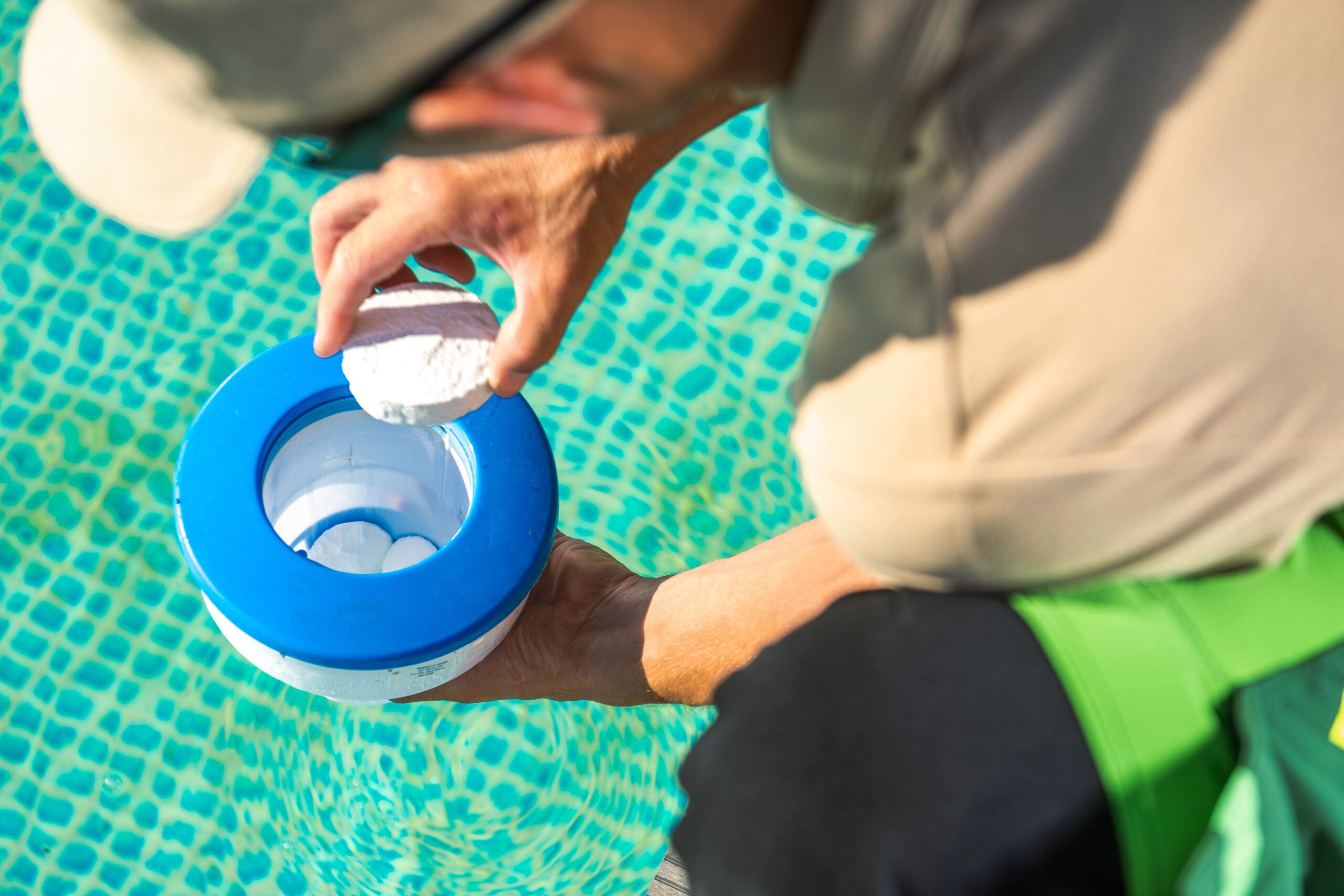
- Add the shock at dusk. Pour liquid chlorine slowly in front of a return jet or around the deep end, close to the water surface to avoid splashing. For granular shock, follow the label: many say to pre-dissolve in a clean plastic bucket of pool water, always adding the chemical to the water, never water to the chemical. Use a separate bucket for each chemical.
- Brush the walls and floor if you’re treating algae, to break up the film so chlorine can reach it.
- Run the pump overnight and retest in the morning. If free chlorine fell sharply overnight, the contamination isn’t gone yet; add more to get back to the target and test again later.
- Wait to swim until free chlorine is back in your normal range (and pH is in range), and follow the label’s re-entry instructions.
Shock safety: what can go wrong
Pool chemicals send thousands of people to the ER. A CDC report in MMWR estimated a median of 4,535 emergency department visits per year for pool chemical injuries in the U.S. from 2008 to 2017, and at least 56% of injuries in 2015 to 2017 happened at a home. Most were poisonings from breathing fumes.
- Never mix chlorine types. The CDC says to store each chlorine product separately, including liquid chlorine, cal-hypo and stabilized products like dichlor or trichlor. Cal-hypo and trichlor can react violently and even explode if they meet in a bucket, a chlorinator or a trash can.
- Never mix chlorine with acid. Chlorine plus muriatic acid releases chlorine gas. The New York State Department of Health describes a home explosion caused by mixing pool shock with hydrochloric acid in a kitchen pan.
- Don’t put cal-hypo in a trichlor tablet feeder or floater.
- Store shock cool and dry, in its original container. The CDC recommends keeping chemicals below 95°F, out of direct sunlight, away from gasoline or gas-powered equipment, and locked away from children.
- Follow the label. Pool sanitizers are EPA-registered pesticides, and EPA states that the label is the law: using a product inconsistently with its label violates federal law.
If someone swallows pool chemicals or has trouble breathing after exposure, call 911 or Poison Control at 1-800-222-1222.
Products worth a look
Widely sold, well-reviewed options that match the advice above. We have not tested them ourselves; check the label, size and compatibility with your pool or spa before you buy. Prices change often, so we don’t list them.
- Taylor K-2006C Complete Pool Water Test Kit: FAS-DPD drop kit that reads free and combined chlorine accurately at shock levels. Check price on Amazon
- Taylor K-1515-A FAS-DPD Chlorine Drop Test Kit: compact free and combined chlorine test for checking breakpoint. Check price on Amazon
Common mistakes to avoid
- Under-dosing. One bag of shock in a large pool with algae often doesn’t reach breakpoint and leaves you with more chloramines. Calculate the dose; don’t guess.
- Ignoring stabilizer. At 80 ppm CYA, a “shock” of 10 ppm does very little against algae. Test CYA before treating algae.
- Shocking at noon in an unstabilized pool, where sunlight burns off much of the chlorine.
- Using dichlor shock every week. Each 10 ppm of chlorine from dichlor adds about 9 ppm of CYA, which builds up all season.
- Letting granules sit on a vinyl liner. Undissolved cal-hypo can bleach and weaken vinyl. Pre-dissolve or broadcast with the pump on, per the label.
- Trusting a test strip at high chlorine. Strips and DPD tests can bleach out above 10 ppm and show zero. Use a FAS-DPD kit or dilute the sample with distilled water.
- Shocking a pool that won’t clear for another reason. If water stays cloudy with good chlorine, the problem may be filtration, pH or calcium. Try our pool problem diagnostic.
Frequently asked questions
How often should you shock a pool?
Many shock labels suggest weekly treatment, but the better guide is your test kit. Shock when combined chlorine reaches 0.5 ppm, after heavy use or heavy rain, and whenever you see cloudiness or algae. A lightly used pool with steady free chlorine and zero combined chlorine may go weeks without one.
How much shock do I need for a 10,000-gallon pool?
For a routine shock to about 10 ppm from a starting level near 2 ppm, you’d add about 8 ppm: roughly 2/3 gallon of 12.5% liquid chlorine or just under 1 lb of 73% cal-hypo. Algae in a stabilized pool needs much more, based on your CYA level.
Can I use household bleach to shock a pool?
Yes, plain unscented bleach is sodium hypochlorite, the same chemical as pool liquid chlorine, just weaker. Check the label strength and avoid scented, “splash-less” or added-detergent versions. At about 6%, you need roughly twice as much as 12.5% pool chlorine.
Should I shock before or after adding other chemicals?
Adjust pH and alkalinity first, wait a few hours with the pump running, then shock. Add clarifiers or algaecides only after chlorine has dropped back toward normal, unless the product label says otherwise. Never add two chemicals at the same time or in the same spot.
Why is my pool still cloudy after shocking?
Dead algae and particles often cloud water for a day or two while the filter catches up. Keep the pump running and clean the filter. If it stays cloudy, see our guide to clearing cloudy pool water.
Sources
- CDC: Home pool and hot tub water treatment and testing
- Indiana Department of Health: How to shock the pool (chlorinate to breakpoint)
- New York State Department of Health: Contamination response recommendations for pool staff
- CDC: Pool chemical safety
- CDC MMWR: Pool chemical injuries in public and residential settings, 2008–2017
- New York State Department of Health: Swimming pool chemicals
- EPA: Introduction to pesticide labels
- Trouble Free Pool: Understanding the chlorine/CYA chart