Quick answer: cloudy pool water comes from one of three things: weak sanitizer, unbalanced water (usually high pH or calcium) or a filter that is not catching fine particles.
Test first. If free chlorine is low or combined chlorine is above 0.5 ppm, shock the pool. If pH is above 7.8, lower it to 7.4–7.6. Then run the pump 24 hours a day and clean the filter when pressure rises 8–10 psi above its clean reading. Add a clarifier only once the chemistry is right; most pools clear in 1–3 days.
This guide contains Amazon affiliate links. As an Amazon Associate, we earn from qualifying purchases, at no extra cost to you. Learn more.
Key takeaways
- Cloudiness is a symptom, not a diagnosis. Test free chlorine, combined chlorine, pH, total alkalinity, calcium hardness and CYA before you buy anything.
- Low free chlorine is the most common cause. A cloudy pool with low chlorine is often an algae bloom in its early, not-yet-green stage.
- Milky white haze after adding baking soda, soda ash or cal-hypo usually means calcium carbonate dropping out of solution because pH or alkalinity went too high.
- The filter does the clearing. Run the pump around the clock and keep the filter clean while you fix the water.
- Clarifier helps the filter catch fine particles over 24–48 hours. Flocculant drops them to the floor overnight but requires vacuuming to waste.
What causes cloudy pool water
Orenda Technologies, a pool chemical maker, lists the main causes of cloudy (“turbid”) water as carbonate clouding, algae, fine dirt and debris, body oils and lotions, filter problems and poor circulation. They fall into three groups.
Sanitizer problems
When free chlorine (FC) runs low, bacteria and algae start growing before you can see color. The water turns dull, then hazy, then green. High combined chlorine (CC), the used-up chlorine that forms when chlorine reacts with sweat, urine and other organics, is another sign the sanitizer is losing ground. The CDC’s minimum for home pools is 1 ppm FC, or 2 ppm if you use cyanuric acid (CYA) or stabilized tablets. Stabilized pools actually need more than that minimum to stay ahead of algae; our shock guide covers the target levels by CYA.
Water balance problems
Water can only hold so much dissolved calcium carbonate. Push pH, total alkalinity (TA), calcium hardness (CH) or temperature too high and the excess comes out of solution as a fine white haze, which later settles as dust or scale. Orenda flags a Langelier Saturation Index (LSI) above +0.30 as scale-forming and notes that soda ash commonly clouds water by causing a sudden spike. Hard fill water and cal-hypo shock in plaster pools make this more likely. Fix it by lowering pH; see how to raise or lower pool pH and how to adjust total alkalinity.
Filtration and circulation problems
Even perfectly balanced water goes cloudy if the filter cannot remove fine particles. Common causes: the pump runs only a few hours a day, the filter is overdue for cleaning, sand is old and channeled, a cartridge is torn, a DE grid is broken, or a return is pointed so water stagnates in a corner. Pollen, dust storms and heavy swimmer loads add more particles than a weak filter can handle.
Diagnose it: what the haze is telling you
Match what you see with what your test kit says. The fix is different for each.
| What you see | Likely cause | First fix |
|---|---|---|
| Dull or hazy, FC low or zero | Sanitizer too weak, early algae | Shock to the level for your CYA |
| Hazy with a green or teal tint | Algae bloom | Shock and hold, brush daily |
| Milky white after adding baking soda, soda ash or cal-hypo | Calcium carbonate precipitating | Lower pH to 7.2–7.4, filter it out |
| Cloudy right after a shock treatment | Dead algae and debris | Keep filtering, clean the filter, vacuum |
| Hazy with chlorine and pH in range | Fine particles the filter misses | Clean filter, run 24/7, add clarifier |
| Cloudy after a party, with greasy film at waterline | Oils, lotions, heavy bather load | Shock, clean filter, skim film |
| Fine white dust settling on the floor | Calcium, DE or phosphate-remover dust | Check filter for leaks, vacuum |
Not sure which row fits? Our pool problem diagnostic walks through the symptoms one at a time.
Target levels for clear water
Compare your test results with these ranges. The CDC sets the safety floor; the “ideal” ranges come from Trouble Free Pool’s recommended levels for chlorine pools.
| Test | Acceptable range | Ideal range |
|---|---|---|
| Free chlorine | CDC minimum 1 ppm; 2 ppm with CYA | About 7.5% of CYA or more (e.g., 5–7 ppm at CYA 40) |
| Combined chlorine | 0.5 ppm or less | 0 ppm |
| pH | 7.0–7.8 (CDC) | 7.4–7.6 for clarity; 7.6–7.8 ideal for many pools |
| Total alkalinity | 50–90 ppm | 60–80 ppm |
| Calcium hardness (plaster) | 250–650 ppm | 350–550 ppm |
| CYA, chlorine pool | 30–60 ppm | 40–50 ppm |
Vinyl and many above-ground pools can run lower calcium (50–550 ppm) because there is no plaster to protect. If your TA and CH are both at the top of their ranges, keep pH closer to 7.4 to avoid clouding. Plug your numbers into our pool calculator to work out chemical doses for your volume.
How to clear cloudy pool water: step by step
- Test the water. Use a liquid kit that reads FC, CC, pH, TA, CH and CYA. The CDC notes that DPD chlorine tests can read falsely low above 10 ppm and that strips are less accurate than kits.
- Clean the skimmer and pump baskets. Restricted flow means the filter sees less water.
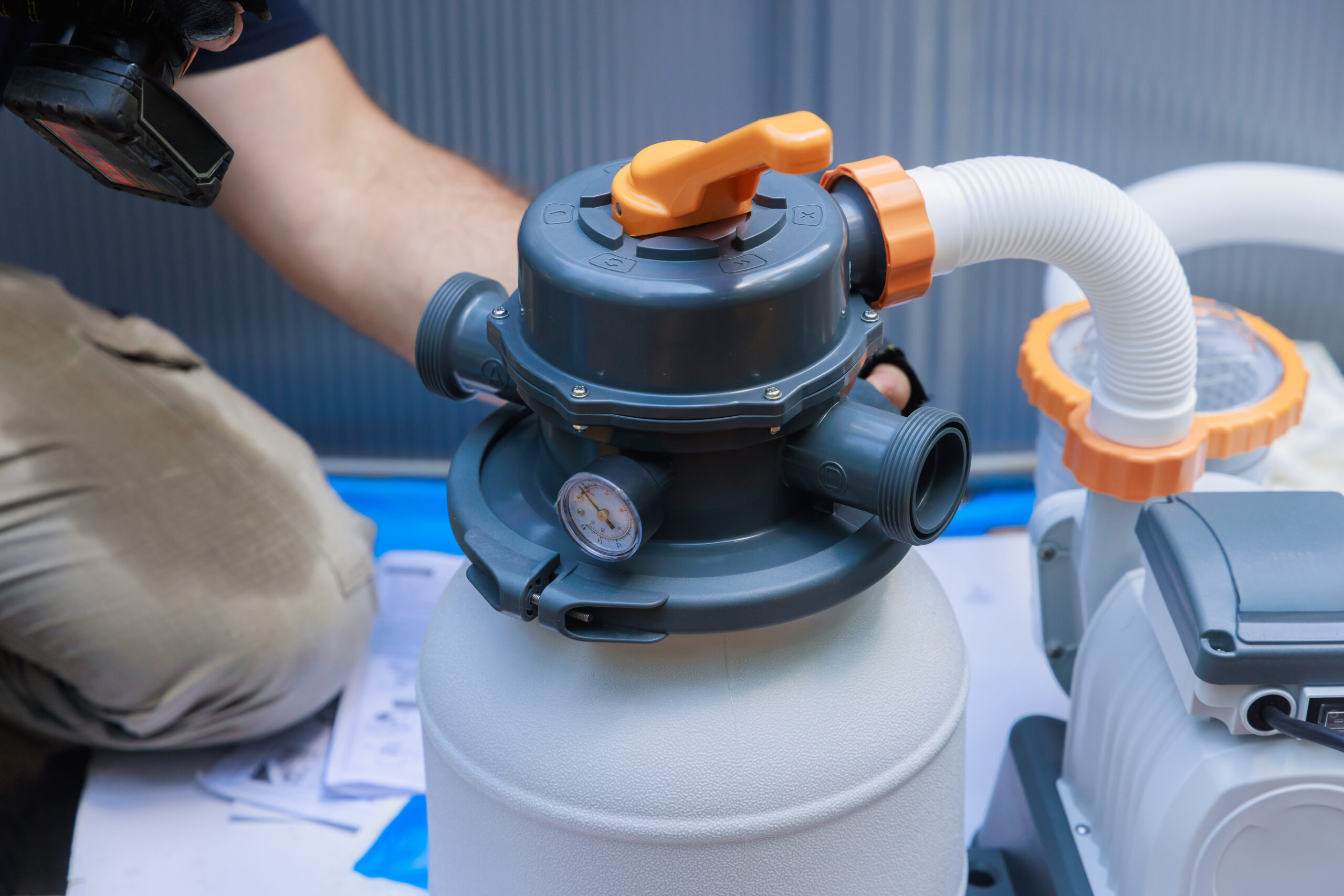
- Clean or backwash the filter. Hayward’s sand filter manuals say to backwash when the gauge reads 8–10 psi above the clean starting pressure. Hose off cartridges; backwash and recharge DE filters with fresh DE per the filter label.
- Fix pH. If pH is above 7.8, lower it to about 7.4 with muriatic acid (commonly 31.45%) or dry acid (sodium bisulfate), following the label. Add acid slowly in front of a return with the pump running and never at the same time as chlorine.
- Shock if FC is low or CC is above 0.5 ppm. Raise FC to the shock level for your CYA with liquid chlorine or cal-hypo. If you see a green tint, follow our green pool guide instead, because algae needs the level held for days, not a single dose.
- Run the pump 24 hours a day. Keep it running until the water is clear. Point the returns down and around so the whole pool circulates.
- Brush and vacuum. Brush walls and floor daily and vacuum debris that settles.
- Wait 24 hours, then retest. If chemistry is right and the water is still hazy, add a clarifier at the label dose.
- Watch filter pressure. As the filter catches more particles, pressure rises. Clean it again when it climbs 8–10 psi over clean.
Pool clarifier vs. flocculant
Both products make tiny particles clump together. The difference is where the clumps go.
| Clarifier | Flocculant | |
|---|---|---|
| How it works | Clumps fine particles so the filter catches them | Forms heavy clumps that sink to the floor |
| Pump | Runs continuously | Runs about 2 hours, then off to let it settle |
| Time | 24–48 hours (HTH) | 8–12 hours settling, then vacuum (HTH) |
| Cleanup | Clean filter after | Vacuum slowly to waste |
| Best for | Mild to moderate haze | Very cloudy water, sand or DE filters with a waste setting |
Doses vary a lot by brand. HTH Clarifier Advanced, for example, calls for 2 fl oz per 10,000 gallons, or 4 fl oz for extremely cloudy water, while other clarifiers call for 16 oz or more as a first dose. Read your product’s label. HTH also advises against backwashing for at least 24 hours after adding clarifier so the filter can hold the clumps, and says to wait 4–12 hours after shocking before adding it. If you need clarifier every week, the real problem is usually a dirty filter, short pump run time or water that needs rebalancing.
Flocculant works fast but is messy. You must vacuum to waste, bypassing the filter, or you will push the clumps right back into the pool. Most cartridge filters have no waste setting, so floc is a poor fit unless you can pump the debris out another way.
How long it takes, and what it costs
Mild haze with good chemistry often clears in 24–48 hours of continuous filtration, which matches HTH’s 24–48 hour window for clarifier. Cloudiness after an algae treatment can take several days. Trouble Free Pool notes that sand filters are the slowest at removing dead algae, DE the fastest and cartridges in between. If you are weighing a filter upgrade, see our sand vs. cartridge vs. DE comparison.
Cost is usually small if you catch it early: a dose of chlorine or acid and, if needed, one bottle of clarifier. The expensive cases are mechanical: old sand that needs replacing, a torn cartridge, a cracked DE grid or a pump that cannot move enough water. If the water stays cloudy after several days of correct chemistry and 24/7 filtration, inspect the filter or have a pool technician look at it.
How to keep pool water from getting cloudy
- Test FC and pH several times a week in swim season. The CDC recommends testing at least twice a day, more often with heavy use.
- Keep FC in the target range for your CYA, and add extra chlorine after parties, storms and heat waves.
- Keep pH between 7.4 and 7.8 and avoid big swings from large doses of soda ash or baking soda.
- Clean the filter on schedule, by pressure rather than by calendar.
- Run the pump long enough to filter the whole pool at least once a day.
- Ask swimmers to rinse off sunscreen and lotion before getting in.
Safety: never mix chemicals, and never add acid and chlorine together or to the same bucket. Add chemical to water, not water to chemical. Wear goggles and gloves for acid, keep children away and store products as the label says. Do not swim until you can clearly see the main drain from the deck; cloudy water hides a swimmer in trouble. For poisoning or chemical exposure, call Poison Control at 1-800-222-1222, or 911 in an emergency.
Products worth a look
Widely sold, well-reviewed options that match the advice above. We have not tested them ourselves; check the label, size and compatibility with your pool or spa before you buy. Prices change often, so we don’t list them.
- Taylor K-2006C Service Complete FAS-DPD test kit: tests every level you need to diagnose cloudiness. Check price on Amazon
- HTH Pool Care Clarifier Advanced: label-dosed clarifier for haze once chemistry is balanced. Check price on Amazon
Common mistakes to avoid
- Adding clarifier before testing. Clarifier cannot fix low chlorine or high pH.
- Using clarifier and flocculant together. They work in opposite ways (filter vs. floor).
- Backwashing right after adding clarifier, which throws away the particles the filter just caught.
- Vacuuming floc through the filter instead of to waste.
- Raising alkalinity with large doses of soda ash, which can cloud the water instantly.
- Running the pump only a few hours a day while trying to clear the water.
- Overdosing clarifier or floc. More is not faster; use the label dose and give it time.
Frequently asked questions
Why is my pool cloudy after shocking?
Two common reasons. Shock kills algae and bacteria, and the dead material makes the water hazy until the filter removes it. Cal-hypo shock also adds calcium and raises pH, which can cause white calcium clouding in pools with high hardness or alkalinity. Keep the pump running, clean the filter and check pH.
Why is my pool cloudy when the chemicals are balanced?
Usually the filter. Very fine particles like pollen, dust and dead algae cells slip through a dirty, worn or undersized filter. Clean the filter, run the pump 24 hours a day and add a clarifier if it is still hazy after a day.
How long does it take to clear a cloudy pool?
Most pools clear in 1–3 days once chemistry is corrected and the pump runs continuously. Flocculant can clear water overnight but requires vacuuming to waste. Cloudiness after an algae bloom can take a week, especially with a sand filter.
Can you swim in a cloudy pool?
No. Cloudy water can mean low sanitizer, and it also hides swimmers underwater. Public pool codes use the same test: the main drain must be clearly visible from the deck. Wait until you can see it and chlorine and pH are in range.
Does baking soda clear a cloudy pool?
No. Baking soda raises total alkalinity and slightly raises pH. If your water is cloudy from calcium, it can make it worse. Only use it when your alkalinity test shows TA is below range.
Sources
- CDC: Home pool and hot tub water treatment and testing
- CDC: Pool chemical safety
- Orenda Technologies: What causes cloudy pool water
- Orenda Technologies: Why soda ash clouds pool water
- Hayward S166T sand filter owner’s manual (backwash pressure)
- HTH Pool Care Clarifier Advanced: directions and FAQ
- Trouble Free Pool: Recommended pool levels